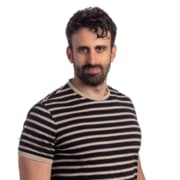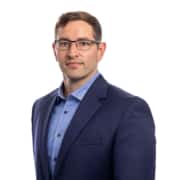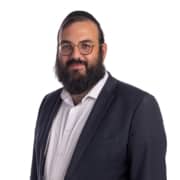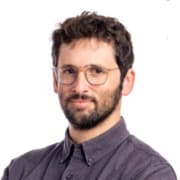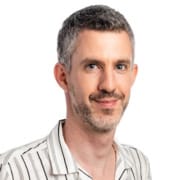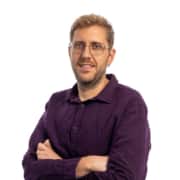
Elad Horn is an architect and a PhD student in the Faculty of Architecture and Town Planning at the Technion – Israel Institute of Technology. His research in the Big Data in Architectural Research Lab (BDAR), under the supervision of Dr. Or Aleksandrowicz, combines the fields of architectural history and digital humanities.

Elad is examining Tel Aviv-Yafo during the 1980s, when Israel’s economy underwent rapid neoliberal restructuring and the city’s architectural style was significantly altered.

His specific interest is in how economic trends, especially those affecting construction and real estate development, helped generate new architectural idioms. To better understand the mechanisms that drive architectural change, Elad employs computational methods such as big data analysis and machine learning for historical research. At a time when cities are undergoing rapid development, Elad hopes to contribute to the academic and public discourse on built heritage and preservation.

Einav Gozansky is a PhD student in in the School of Psychological Sciences at the University of Haifa under the supervision of Prof. Hadas Okon-Singer and Prof. Irit Weissman-Fogel.

Her research combines knowledge from the fields of cognitive psychology, pain physiology, and data science.

She employs advanced machine learning methods to examine the effects of cognitive-emotional computerized trainings on experimental pain outcomes. In her research, Einav trains healthy individuals using different methods and examines changes in cognitive, emotional, and autonomic physiological factors following her interventions. Her research aims to enhance our understanding of basic pain modulation mechanisms and thus facilitate more personalized training interventions that address individual differences in pain perception. This line of research is based on Einav’s expertise in advanced analysis of connections between variables. Previously, she used modelling approaches to explore factors predicting the development of depression symptoms during the COVID-19 pandemic.

Einav grew up in Ramat Gan and currently lives in Haifa. She received her BA in psychology and cognitive sciences from Ben-Gurion University of the Negev and her MA in clinical neuropsychology from the University of Haifa. Einav is also interested in social and environmental activities and has volunteered in a number of social organizations, such as the Green Course, the Summit Institute, and a social development project in Mexico. In her spare time, she enjoys travelling both in Israel and abroad, cooking, yoga, and hanging out with friends.

Dr. Eduardo Arlé is an Azrieli International Postdoctoral Fellow in the George S. Wise Faculty of Life Sciences at Tel Aviv University under the supervision of Prof. Jonathan Belmaker.

His primary areas of research are invasion biology and nature conservation, but his interests extend to method development and programming.

Hundreds of species have migrated from the Red Sea to the Mediterranean Sea through the Suez Canal, establishing alien populations that can disturb the local environment. Understanding the dynamics driving biological invasions is crucial for controlling the spread of species already established and preventing the future introduction of new alien species. However, the methods currently available for predicting species distribution have severe limitations. Eduardo’s research uses the Mediterranean as a case study for developing new methods, best practices, and computational tools to advance invasion biology research and management.

Eduardo was born in Rio de Janeiro and has had a strong interest in observing and understanding nature since childhood. After obtaining a BA in international relations, he felt more drawn to biology and went on to complete a BSc in biological sciences and an MSc in neotropical biodiversity at the Federal University of Rio de Janeiro. He pursued his PhD at the German Centre for Integrative Biodiversity Research (iDiv) Halle-Jena-Leipzig, under the supervision of Dr. Carsten Meyer, where he worked on improving knowledge of alien species distribution by integrating data across scales. Apart from science, Eduardo enjoys travelling, learning languages, cooking, and eating delicious food

Dana Rubinstein is a PhD student in the Department of Jewish Thought at the Hebrew University of Jerusalem under the supervision of Prof. Benjamin Pollock.

Her research focuses on the extensive and largely unpublished collection of working papers by Martin Buber and Franz Rosenzweig which underlies their monumental Bible translation project.

By mining the depths of the Buber-Rosenzweig Bible and the dialogue surrounding it, Dana seeks to demonstrate the possibilities and limitations of Bible translation as a unique exegetical medium and to construct a hermeneutic method for using Bible translations as commentary.

Dana was born in Israel and grew up in Germany, Austria, and the United States. She received her BA in philosophy from Yale University and her JD from Columbia University. She subsequently worked as a litigator at Davis Polk & Wardwell in New York, where she specialized in corporate litigation and white-collar crime but also had the opportunity to work on pro bono asylum cases. She is the co-founder of Dapple, a mission-driven consumer products start-up which makes plant- based cleaners and personal care products for homes with children. In 2014, Dana made aliyah with her husband and four children and returned to academia. Completing her MA in jewish thought at the Hebrew University, she wrote her thesis on Nehama Leibowitz’s exegetical use of translations. In her free time, Dana enjoys reading, listening to music, and experimenting with new recipes and cocktails before unleashing her concoctions on unsuspecting guests.

Cheyn Lambert is an architect and MSc student in the Faculty of Architecture and Town Planning at the Technion – Israel Institute of Technology under the supervision of Prof. Alona Nitzan-Shiftan.

Her research seeks to identify structuralist and semiotic theories in the pedagogy of the Technion’s Faculty of Architecture and Town Planning between 1975 and 1994 through interviews with pedagogues and archived materials.

Through her research, Cheyn hopes to show how structuralist theories bridged the transition of the curriculum from modernism to postmodern teachings. As many of Israel’s leading architects were trained in this era, her research looks to contribute to our understanding of Israel’s current architectural environment.

Cheyn was born in Jerusalem. She grew up in a bilingual home in Canada and Israel and currently lives in Haifa. She received her BSc in design sciences and MArch from the Technion. Cheyn worked as a research assistant during her studies and today continues to develop her thesis- studio project on platforms for marginalized voices in Lod. In addition, she guides historical research projects as a teaching assistant. Having previously volunteered as a Hebrew teacher to immigrant children, she now volunteers as the faculty representative of graduate students, working to advance both the research and social lives of her colleagues while connecting them with one another. Her hobbies include creative experimental pursuits such as painting and crafts, reading, and piano playing.

Dr. Carlos Bravo-Laguna is an Azrieli International Postdoctoral Fellow in the Federmann School of Public Policy and Government at the Hebrew University of Jerusalem under the supervision of Prof. David Levi-Faur.

His research interests cover public policy and crisis management and the evolution of regulatory oversight across the OECD.

In particular, his primary area of research examines crisis networks with a focus on their performance during transboundary incidents. Carlos aims to link structural characteristics of crisis networks to policy outcomes by determining which conditions affect their ability to produce rapid and effective emergency reactions. He thus hopes to contribute to the definition of crisis networks and shed light on how network theory explains crisis management. Carlos is also looking to assess factors that impact the role and weight of EU actors in the governance of external crisis responses.

Carlos has a BA in translation and interpreting from the University of Granada and an MA in international relations from the Barcelona Institute of International Studies (IBEI). He completed his PhD in political and social sciences at the Pompeu Fabra University in Barcelona, exploring the role and weight of the EU in the management of external transboundary crises, and was subsequently a visiting research fellow at University of Konstanz, University of Tübingen and the Hebrew University of Jerusalem. He served as an events officer in the UACES Graduate Forum and is part of the coordination team of the UACES Research Network, RELATE (European Studies in a Relational Universe). His research has been published in various journals, including the Journal of Common Market Studies, the Journal of European Integration, Environmental Sciences Europe, and the Journal of Contingencies and Crisis Management. In his free time, Carlos likes running and hiking with friends. While he considers himself quite sociable, Carlos also enjoys spending quality time at home, reading books, watching films, cooking, or playing computer games.

Aviv Orner is a PhD student in the Seymour Fox School of Education at the Hebrew University of Jerusalem under the supervision of Prof. Adam Lefstein and Dr. Hadar Netz from Tel Aviv University.

She is interested in the connections between language, gender, and sexuality as expressed in public spaces, traditional and social media, and, especially, educational contexts.

Her research focuses on gender equity in classroom discourse in Israeli primary schools. She examines how gender equity can be promoted by developing criteria for interpreting and measuring gender bias in classroom discourse, designing new practices to reduce gender bias (together with teachers in the field), and examining the outcomes and implications of these interventions. She believes her research will contribute to our understanding of the mechanisms of gender inequality in the crucial arena of education and help rectify these inequalities both in the classroom and on the societal level.

Aviv completed her BA in Hebrew linguistics and communication at Oranim College of Education, where she was the head of the student union and a board member of the National Union of Israeli Students. She also worked as a Hebrew teacher in middle school. She completed an MA in the Program for Multilingual Education at Tel Aviv University, where she began researching language and gender in classroom discourse. For as long as she can recall, Aviv has been involved in social and educational activism. She was the president of the student council in high school and a youth movement counsellor, completed a year of community service before her military service, and served in the IDF Education Corps. In her free time, Aviv enjoys travelling, learning about new places, cultures, and people, and attending concerts, theatre, and art exhibitions.

Avital Wagner is a PhD student in the Department of Chemistry at Ben-Gurion University of the Negev under the supervision of Azrieli Early Career Faculty Alum Dr. Benjamin Palmer.

Her research focuses on the formation and crystallization pathways of biogenic guanine crystals.

In nature, the assembly and morphologies of these crystals are exquisitely controlled to create different optical phenomena associated with animal coloration and vision. However, almost nothing is known about how organisms make the crystals themselves. Avital follows the morphogenesis of guanine crystals in model organisms during development using cryogenic scanning and transmission electron microscopy and synchrotron x-ray diffraction methods. Her aim is to adapt the strategies used by organisms to the laboratory and develop new green routes for making the artificial molecular crystals used in optics, pharmaceuticals, and other fields.

Avital grew up in Rehovot and currently lives in Be’er Sheva. While growing up, Avital was a competitive swimmer on the Maccabi-Weisgal- Rehovot team. She did her military service as a chemistry and materials lab assistant in the Technology and Maintenance Corps. While completing her BSc and MSc degrees in materials engineering at Ben-Gurion University, she actively participated in tutoring and mentoring students and organizing enrichment activities. Avital’s MSc studies centred on optical properties of doped ceramics, and she has multiple publications resulting from her research. In her spare time, Avital enjoys reading books, playing word games, spending time with family and friends, and hiking around the Negev desert.

Anna Uzonyi is a PhD student in the Department of Molecular Genetics at the Weizmann Institute of Science under the supervision of Prof. Schraga Schwartz.

Her research focuses on understanding the role of chemical modifications of RNA nucleotides.

Of central importance to Anna’s research is deciphering how RNA structure determines the deposition of the RNA modification inosine, which is involved in the immune response to viral infections and plays a role in autoimmune diseases. In an additional research project, Anna is assessing how another modified RNA base regulates the lifespan of RNA molecules, using both experimental methods and computational analysis. Anna hopes that her research will lead to a better mechanistic understanding of RNA modifications and consequently help the development and improvement of RNA-based therapeutics.

Anna was born and raised in Budapest, Hungary. During high school, she had the opportunity to learn university-level biology and experimental methods and participate in national and international science competitions, including the International Biology Olympiad in Switzerland and Indonesia. She moved to Munich, Germany for her undergraduate studies in molecular biotechnology. During her studies, Anna completed several research internships abroad: she studied protein translation at the Weizmann Institute in Israel, influenza virus in Oxford, ovarian cancer in Singapore, and non- coding RNAs in Germany. She moved to Israel to pursue her MSc in life sciences in the Weizmann Institute and stayed for subsequent PhD research. In her free time, Anna enjoys travelling, hiking, and sports activities. She likes reading fantasy and science fiction novels and is enthusiastic about cooking, baking, and cake decoration. In addition, Anna enjoys debating and has participated twice in the European Universities Debate Championship.

Dr. Anat Arzi is a new faculty member in the Department of Medical Neurobiology and the Department of Cognitive and Brain Sciences at the Hebrew University of Jerusalem.

Her research combines basic and clinical neuroscience to answer how we process the world under loss of consciousness.

Anat’s work focuses on two central unconscious states: natural loss of consciousness during sleep and pathologically altered consciousness following brain injuries. By recording diverse aspects of brain–body activity, her goal is to shed additional light on principles underlying the ability to process the world around us unconsciously. As an Azrieli Fellow, Anat will investigate the neurophysiological processes underlying consciousness recovery in patients with severe brain injuries and develop new methods to detect consciousness and predict recovery in brain-injured patients.

Anat completed her PhD in neurobiology in the lab of Prof. Noam Sobel at the Weizmann Institute of Science. During her doctoral studies she harnessed the unique characteristics of olfaction to study the processing, learning, and memory of unperceived stimuli in wakefulness and sleep and discovered that, in contrast to previous notions, humans can learn novel information during sleep. In her postdoctoral work, she pursued the investigation of unconscious brain abilities and limits in the labs of Prof. Tristan Bekinschtein at the University of Cambridge and Prof. Jacobo Sitt at the Paris Brain Institute. She developed an innovative approach for consciousness detection, demonstrating that olfactory sniffing can serve as a biomarker for consciousness recovery in brain-injured patients. Anat lives with her spouse, Gadi, and their daughter, Naomi, and enjoys poetry, French patisserie, and yoga.