Protected: Rewriting the Cancer Code

There is no excerpt because this is a protected post.

Photographs by Avital Hirsch
October 14, 2026 By Dan Falk
View PDF version

“I feel like I was born a scientist.”

Christina Riemenschneider is only half joking. Growing up in Ahrbergen, a small town south of Hanover, Germany, she was entering science fairs by the seventh grade. “I never wanted to do anything else,” she says.

Today, that lifelong curiosity is focused on one of medicine’s most stubborn challenges: understanding how cancer cells adapt, survive and resist treatment. As an Azrieli International Postdoctoral Fellow in the Department of Immunology and Regenerative Biology at the Weizmann Institute of Science, Riemenschneider investigates epigenetics, a biological process that has transformed scientists’ understanding of cancer over the past two decades.

Most people know that genes play a major role in shaping who we are. Our DNA influences everything from physical traits to susceptibility to disease. But genes are only part of the story. Scientists now recognize that, although DNA provides the fundamental instructions, epigenetics also plays a key role, acting as a set of chemical switches that can turn specific genes on or off.

If DNA is like the text of a book, epigenetics functions like a system of highlights, bookmarks and sticky notes, directing cells to read some passages while skipping others. These chemical instructions do not alter the genetic code itself but can dramatically affect how that code is used.

The distinction is particularly important in cancer research. While genetic mutations are often permanent, many epigenetic changes can be reversed. “That opens up new possibilities for treating cancer, because drugs can erase the bad marks and wake up genes that protect against tumours,” says Riemenschneider. Cancer treatments traditionally focus on destroying tumour cells, but epigenetic therapies offer another possibility: reprogramming them. By restoring more normal patterns of gene activity, researchers hope to slow tumour growth, make cancers more vulnerable to existing therapies, and prevent resistant cells from gaining the upper hand.

Share this article
“Rather than seeing a tumour as a single mass, scientists can now identify and observe distinct populations of cells, essential for understanding how treatment-resistant cells emerge and evolve”

After earning a degree in medical biotechnology at the Technical University of Berlin, Riemenschneider completed her PhD at the nearby Max Planck Institute for Molecular Genetics, where she began specializing in epigenetics. Riemenschneider’s research to date has shown how cells exert more active control over their genomes than previously thought — using epigenetic mechanisms not only to preserve cellular identity but also to silence potentially disruptive genetic elements. For example, certain DNA sequences can copy or cut and paste themselves into different locations in the genome. This can cause mutations that may lead to cancer or other diseases.

During her PhD, she studied what allows stem cells to remain so flexible that they can develop into almost any type of cell in the body. Her research helped reveal the molecular “locks” that normally keep cells fixed in their roles. These locks, known as epigenetic barriers, prevent cells from changing their identity. She showed how by loosening or removing these barriers, cells can be reprogrammed back to a more youthful, adaptable state, where they once again have the potential to become many different kinds of cells. Her current research builds on that foundation by exploring why some cancer cells survive treatment when most do not.

The answer may lie in the remarkable flexibility of cancer cells. Under normal circumstances, epigenetic mechanisms help the body’s cells perform different functions despite sharing the same DNA. A brain cell and a skin cell contain essentially identical genetic instructions, yet epigenetic signals allow them to behave in different ways.

In cancer, however, these control systems can go awry. More than half of human cancers are associated with mutations in enzymes that regulate chromatin — the complex mixture of DNA and proteins that packages genetic material inside cells. When chromatin organization is disrupted, gene activity can become distorted. Cells may activate programs that encourage growth and survival while shutting down safeguards that normally prevent tumours from forming. The result is a disease that is constantly changing. Cancer cells can adapt to hostile conditions, spread to new tissues, and evolve resistance to treatments. Tumours become ecosystems of diverse cell types, each with distinct characteristics and survival strategies. Understanding those differences is at the heart of Riemenschneider’s work.

At the Weizmann Institute laboratory of molecular biologist Efrat Shema, whose research group works to decode the “cancer epigenome,” Riemenschneider studies the cells that withstand chemotherapy and other treatments. Her goal is to identify the epigenetic changes that allow those cells to survive and then find ways to reverse them.

Her typical day in the lab is part biology, part detective work. Some days, Riemenschneider and her colleagues prepare tumour samples and run experiments designed to reveal the molecular state of individual cells. Other days are spent at a computer, sifting through enormous datasets generated by those experiments. A single tumour sample can contain thousands of cells, each with its own molecular profile. The challenge is to spot patterns hidden within that complexity: Which cells are responding to treatment? Which are resisting it? And what distinguishes one group from the other?

“We want to understand the cells that lead to relapse and drive metastasis — the spread of cancer to other parts of the body, which is the main cause of death in cancer patients. We also want to understand the cells that are resistant to chemotherapy or other therapies,” she says. “Then it’s a matter of finding solutions that will make them revert back to an earlier cell state, so that we can kill them via chemotherapy or other therapies.”

Breast cancer provides an especially important testing ground for these ideas. It is the most common cancer among women worldwide and remains a leading cause of cancer deaths. One reason it can be so difficult to treat is that no two tumours are exactly alike. In fact, even within a single tumour, multiple populations of cancer cells may coexist.

These cells are not fixed. They can shift from one state to another, altering their behaviour as conditions change. Scientists refer to this phenomenon as tumour heterogeneity, and it is one of the reasons cancers often respond unpredictably to treatment. “The ability of breast cancer cells to change and adapt likely explains why the disease is so aggressive and hard to treat, and why it often comes back,” Riemenschneider says.

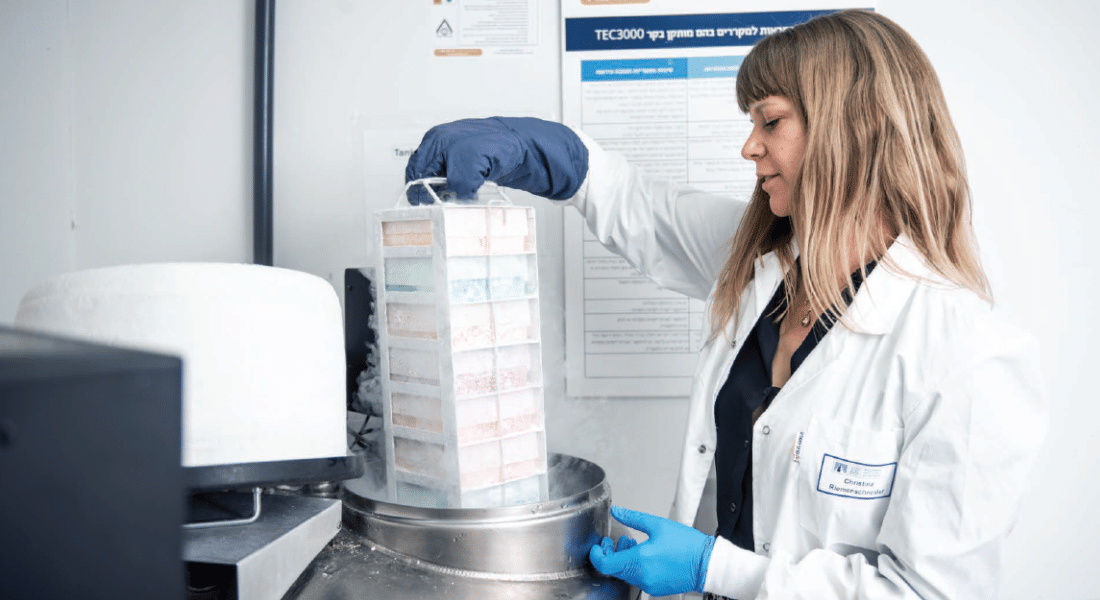
Riemenschneider retrieves a rack of frozen biological samples from cryogenic storage. Her team is exploring drugs that target specific epigenetic markers and “liquid biopsy” technologies that could enable early detection of cancer.

Chemotherapy remains one of the most powerful weapons against cancer, but it has limitations. While it may destroy the vast majority of tumour cells, a small number sometimes survive. Those survivors are often the most resilient and dangerous cells in the tumour.

To understand what distinguishes those surviving cells, Riemenschneider employs advanced single-cell technologies that allow researchers to study the epigenetic network of individual cells rather than averaging measurements across an entire tumour. One technique, known as cytometry by time of flight, or CyTOF, can analyze thousands of individual cells and reveal subtle differences between them.

The technology works by attaching tiny heavy metal tags to antibodies that can act as “barcodes” marking different proteins or epigenetic modifications inside cells. Those cells then pass through an instrument called a CyTOF mass cytometer, a highly specialized machine that uses mass spectrometry to measure the abundance of these metal tags on antibodies and other tags in single cells. This allows researchers to track dozens of biological markers at once and offers a detailed snapshot inside each cell.

Rather than seeing a tumour as a single mass, scientists can identify distinct populations of cells and observe how they change over time. For researchers like Riemenschneider, that level of detail is essential for understanding how treatment-resistant cells emerge and evolve.

Her team is also exploring drugs that target specific epigenetic markers, as well as blood-based “liquid biopsy” technologies that could someday help physicians detect cancer earlier and monitor its evolution without invasive procedures. Efrat Shema believes the work could have far-reaching implications. “Christina has already made many important discoveries,” she says. Her research on breast cancer, Shema adds, is of “major importance for our understanding of this aggressive and heterogeneous disease, with clear clinical implications.”

For Riemenschneider, the ultimate goal is straightforward, even if the path is not.

Cancer is not a single disease but a vast collection of diseases, each driven by different molecular mechanisms. That diversity is one reason a universal cure remains elusive. Progress comes instead through careful investigation of specific questions, such as how epigenetic changes help breast cancer cells evade treatment.

Riemenschneider’s research already points toward novel approaches to treating a particularly aggressive form of breast cancer. Many breast cancers are driven by the estrogen receptor, a protein inside cancer cells that responds to the hormone estrogen and tells the cells to grow. These cancers can be treated effectively with drugs like tamoxifen, which blocks the estrogen receptor and cuts off the cancer’s fuel supply. But a particularly aggressive form of breast cancer known as triple-negative breast cancer (TNBC) lacks the estrogen receptor, so tamoxifen has nothing to target.

Riemenschneider discovered that TNBC cells do not necessarily lack the estrogen receptor permanently; rather, they are “silenced” by epigenetic mechanisms. She was able to use inhibitors against epigenetic modifiers — molecules that interfere with the machinery responsible for keeping the gene turned off — that reactivated the estrogen receptor in these cells. Once the receptor was switched back on, the cancer cells became sensitive to tamoxifen again. A previously ineffective drug could now potentially be used to treat tumours.

Although Riemenschneider’s work is driven by the goal of improving cancer treatment, it remains largely basic research, focused on understanding the fundamental biology of how cancer cells change their behaviour and evade therapy. But the gap between basic research and medicine is smaller than it once was. Several drugs that target epigenetic processes are already approved for certain blood cancers, and researchers are testing others in clinical trials. Scientists hope that insights from studies like Riemenschneider’s will eventually help doctors identify patients at risk of developing treatment resistance and design therapies that can stop that process before it begins.

It is a significant challenge. Yet when Riemenschneider talks about her work, what comes across most clearly is not the difficulty of the problem but her enthusiasm for solving it. She says being an Azrieli Fellow acted as a catalyst: “It connected me with scientists from so many different fields, which I truly love,” she says. “It’s incredibly inspiring to discuss topics outside of my own research, and the activities we’ve shared have really helped bring the scientific community closer together.”

Riemenschneider also draws inspiration from the natural world and her hobby of collecting intriguing stones. “Each stone tells a geological story,” she says, “and it’s not so different from what I do in my research, looking closely at layers of information to understand how something complex came to be. The desert, in particular, has a kind of quiet beauty that I find deeply inspiring. There is something humbling about standing in a landscape that has been shaped by time and natural forces far greater than ourselves.”

 

Subscribe to our newsletter

* indicates required

All fields are mandatory.