It’s no surprise that in Israel, mental health is an increasingly significant issue after years of war have weighed on the nation. However, not everyone understands its link to addiction. One survey conducted in 2024 found that 26 per cent of Israelis are using addictive substances, an increase of 15 per cent from 2022.
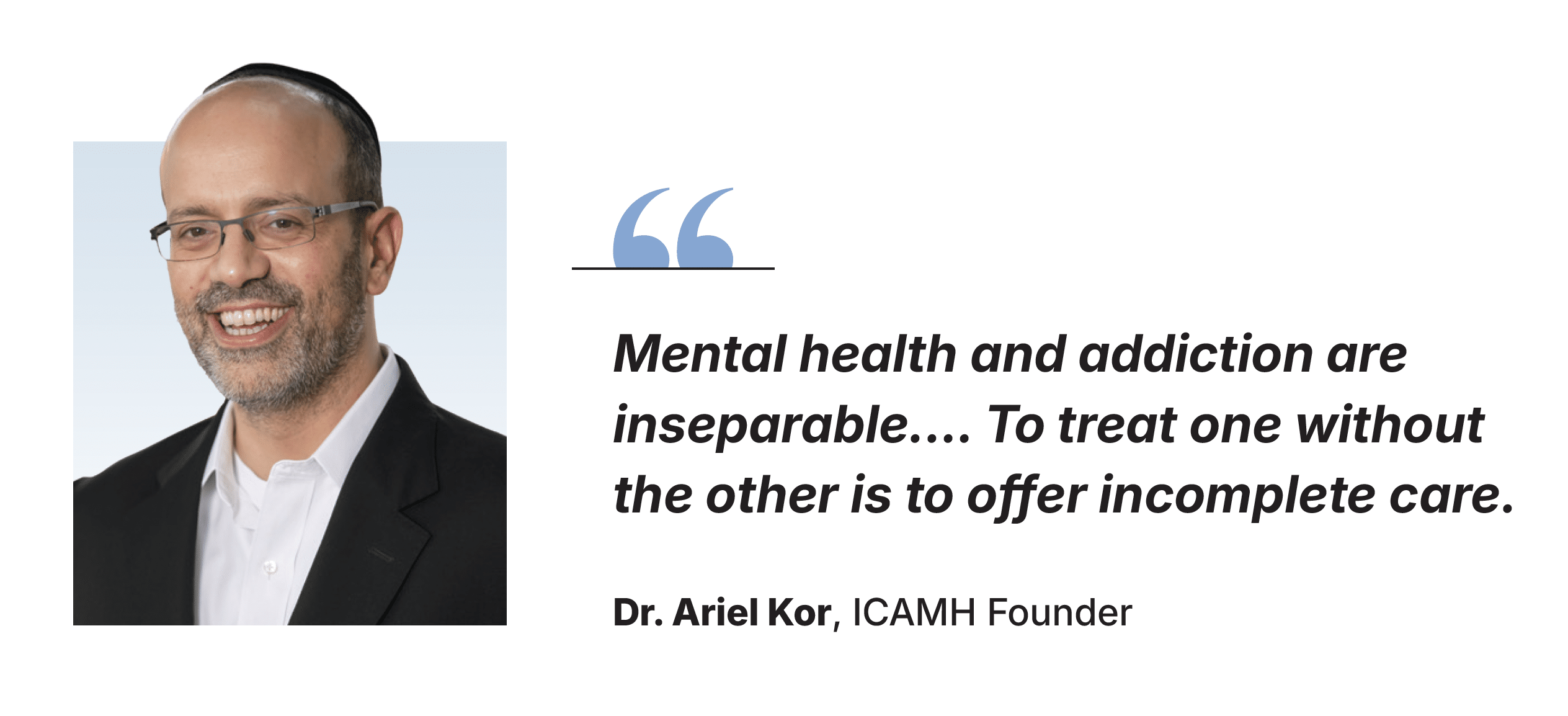
“Mental health and addiction are inseparable,” notes Dr. Ariel Kor, founder of the Israel Centre for Addiction and Mental Health (ICAMH), Chair of the Israel Centre on Addiction (ICA) and a clinical psychologist. “Our clinics embody the understanding that trauma, life crises and emotional distress are inherently linked to harmful substance use and addictive behaviours. To treat one without the other is to offer incomplete care.”
Enter ICAMH, the first and only institution in Israel that intertwines research and care for both psychiatric and addiction issues. The centre, which opened in November 2025, was built in large part thanks to a $25-million donation from the Azrieli Foundation to Hebrew University, to create an academic centre, and it opened at the right time. “After October 7, a huge number of people are coming to receive treatment for both trauma and addiction problems,” says Dr. Mario Mikulincer, Academic Director of ICAMH.
Creating a space for treatment
The centre consists of two buildings that are each six storeys tall and house clinical and teaching areas, group therapy rooms, research labs and office space. The buildings are surrounded by well-manicured green spaces, while the interiors boast plants, natural wood accents, modern design and an abundance of natural light.
Creating a beautiful and welcoming space was intentional. “Mental health and addiction should not be relegated to hidden or neglected corners. By providing a dignified, state-of-the-art environment, we convey to our patients that they are worthy of the highest standard of care,” explains Kor.
The Foundation’s contributions extend beyond building ICAMH’s facilities. It also provides the administrative and human resources necessary to advance the institution’s research, teaching and clinical care goals.
Naomi Azrieli, Chair of the Azrieli Foundation, explains that by bringing together these three areas, which focus on community care, research, education and specialized care, ICAMH “has the potential to shift the whole ecosystem related to mental health and addiction in the country.”
The hope is that ICAMH will improve treatment for those struggling with addiction and mental health challenges, and help to reduce societal stigma around these issues. “Since October 7 and the ensuing war, people talk a lot about PTSD, trauma and mental health issues in society, but addiction is still hugely taboo. It’s still seen as a personal failure,” says Azrieli. “We are proud to put our philanthropy and our name behind ICAMH to help normalize care for mental health and addiction in Israel.”
Cross-discipline care
Another unique feature of ICAMH is that it integrates clinical care and research across a wide range of disciplines including psychology, pharmacy, genetics, philosophy, social work and computational science. This means researchers can tackle the complex challenges of addiction and mental health with comprehensive solutions.
One example of how this collaboration can help is around the use of psychedelics in treating PTSD, says Mikulincer. While these drugs can be effective, they can also induce fear or simply offer a distraction rather than healing. By bringing together a pharmacist and a cognitive psychologist on a research project, ICAMH can build a new therapy in which an individual is exposed to triggers in a safe environment, assisted with psychedelics.
ICAMH also breaks down walls between research and clinical care. “Traditionally, public health systems, academia and field-level NGOs operate in isolation,” says Kor. “This fragmentation creates gaps in the continuum of care and separates research from real-world application.”
Academics, for instance, might focus on research pursuits that don’t meet the day-to-day needs of patients. Healthcare providers, meanwhile, might provide care without the latest scientific evidence. By bringing these two sides together, ICAMH ensures that its research answers the questions that front-line doctors, nurses and psychologists want answered. “The close partnership ensures that good research gets implemented in the clinic, and then what’s learned in the clinic goes back into research. It’s a virtuous loop,” says Azrieli.