In perfect harmony

When music education is well supported, students learn to flourish.

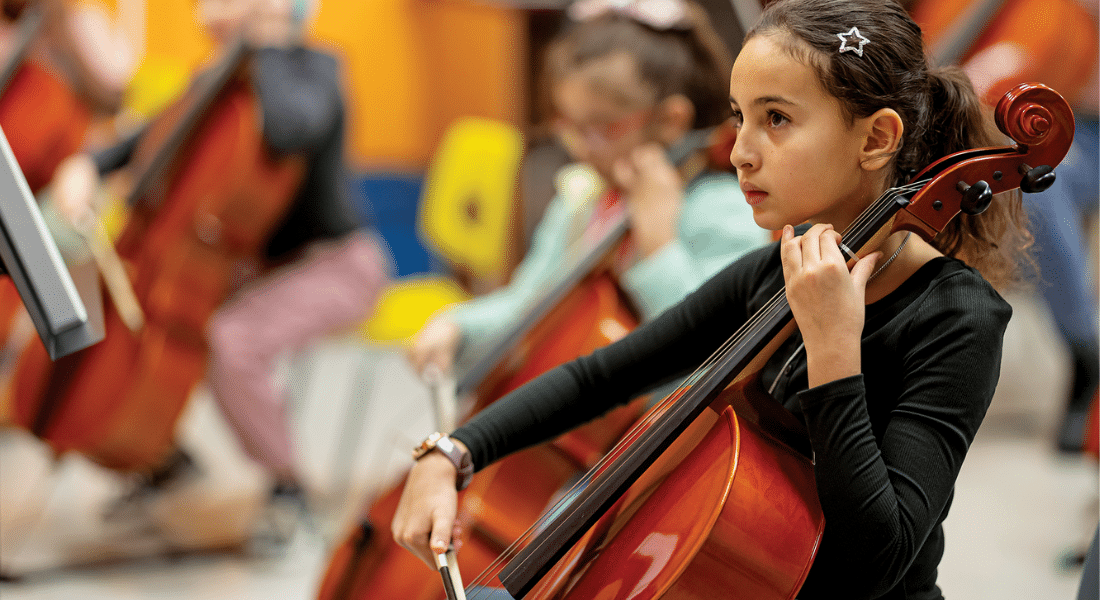
Thanina Hamiche plays her cello during rehearsal in El Sistema OSM Program. Photo: Antoine Saito

The first time 11-year-old Thanina Hamiche held a cello, she was extremely nervous. The Montreal student’s impression was that playing an instrument was for children with talent—something she didn’t believe she had.

“I was afraid of making mistakes, afraid of not being good enough,” she writes in a thank-you letter to the Azrieli Foundation. “But as soon as I played my first notes, something incredible happened: it felt as if the world around me suddenly became bigger and brighter.”

Hamiche is one of thousands of young people in Canada supported by the Foundation’s commitment to empowering children through music. L’Orchestre Symphonique de Montréal’s program and others like it are modelled after El Sistema, a social music education program founded in 1975 by Maestro José Antonio Abreu for disadvantaged Venezuelan children. Giving students free access to ensemble-based classical music instruction, Abreu believed, could create the conditions for young people to increase their confidence, discipline, self-esteem and hope for a better future.

Sistema-inspired organizations now span over 40 countries across Asia, Europe and the Americas, but the core principles remain the same. Music lessons and instruments are free to children from underserved communities; programming is intensive, with students attending for several hours after school, four or five days a week; and the program is progressive, which means students can (and usually do) participate throughout their elementary years and sometimes into high school.

The power of music

Decades of research have shown the lasting positive effect music education has on students’ social, academic and emotional well-being. A 2018 study found that primary school children who received one to two hours of music lessons per week during class time showed improved executive function skills such as planning and impulse control.

When Jason van Eyk, Managing Director of the Azrieli Music, Arts and Culture Centre, joined the Foundation in 2016, El Sistema was already on his radar.

He’d been following its impact since 2008 when Abreu was awarded the prestigious Glenn Gould Prize and brought his Simón Bolívar Symphony Orchestra to play at the Prize gala in Toronto.

According to van Eyk, supporting Canadian Sistema-inspired programs was a natural fit for the Foundation, perfectly aligning with its mission to empower youth through high-quality education.

“They’re not just teaching kids how to play music, they’re helping them build core competencies for lifelong success,” he says. “Through music, students learn perseverance, commitment, collaboration and how to handle frustration and failure. Over time, they also develop a sense of care and responsibility to their ensemble, to themselves and to their instruments.”

The 18 Sistema-inspired programs across Canada are as different as the communities they serve, yet they share the common goal of giving children from underserved communities a place to grow, belong and explore their potential through music. The effect, says van Eyk, is extraordinary. “In nearly every music education program the Azrieli Foundation has supported, 100 per cent of the students graduate from high school and 100 per cent of them go on to post-secondary education.”

From philosophy to practice

The conviction that music can transform lives is the driving force behind Sistema New Brunswick. Adapted from the principles behind the original Venezuelan model, it’s one of the largest youth music programs in the country, with 11 locations across the province that teach more than 1,400 students daily.

“From the beginning, we were committed to inclusion, which we defined as kids who are left out,” explains founder and strategic advisor Ken MacLeod. “Low-income families, single-parent families, newcomer families, Indigenous communities. That’s been our guide, our absolute foundational pillar.”

While he acknowledges that not every child in the program goes on to become a professional musician, the focus, discipline and teamwork they develop are foundational skills for any career path they choose.

The program’s success wouldn’t have been possible without the Azrieli Foundation’s support. MacLeod notes that a “yes” from the Foundation was a catalyst for additional funding from private donors, thanks to its stature in the world of philanthropy.

“They’ve been a tremendous partner,” says MacLeod. “Vital in our overall growth, development and the capacity to achieve our vision and goals.”

Deep belonging

In Ottawa, OrKidstra tells a similar story but with its own distinct voice. Co-founder and Artistic Managing Director Tina Fedeski didn’t want to replicate El Sistema exactly, instead choosing to use it as inspiration to create something new. The result is a thriving organization that offers children from lower-income neighbourhoods a range of different music experiences, including a string ensemble, a wind-instrument group, early-childhood music education on instruments like the recorder and more.

“The essence of the Sistema program was what resonated, because it was about accessibility, passion, commitment, belonging,” Fedeski explains, adding that these elements are key to a meaningful life.

The impact can be seen in the program’s graduates, all of whom have gone on to post-secondary education with a greater sense of love and belonging.

“OrKidstra changed my kids’ lives. It turned shy children into confident performers. And because it’s free, families like mine can access opportunities that would otherwise be impossible,” says former OrKidstra parent and current program ambassador Kelly Lee Evans.

That, more than musical skill, is how Fedeski defines success. “Our goal is not to create virtuoso musicians, but rather to help nurture virtuoso human beings. And sometimes we do both.”

In Montreal, Thanina Hamiche and her friends experience the impact of the Foundation’s generosity at every rehearsal. Not just because of the music they learn or the cellos they play on, but because these programs are teaching them to step into their potential.

“Today, thanks to the orchestra …we all feel like we are part of a big team, where every step forward is celebrated,” she writes. “If I can dream bigger now, it is because of you.”
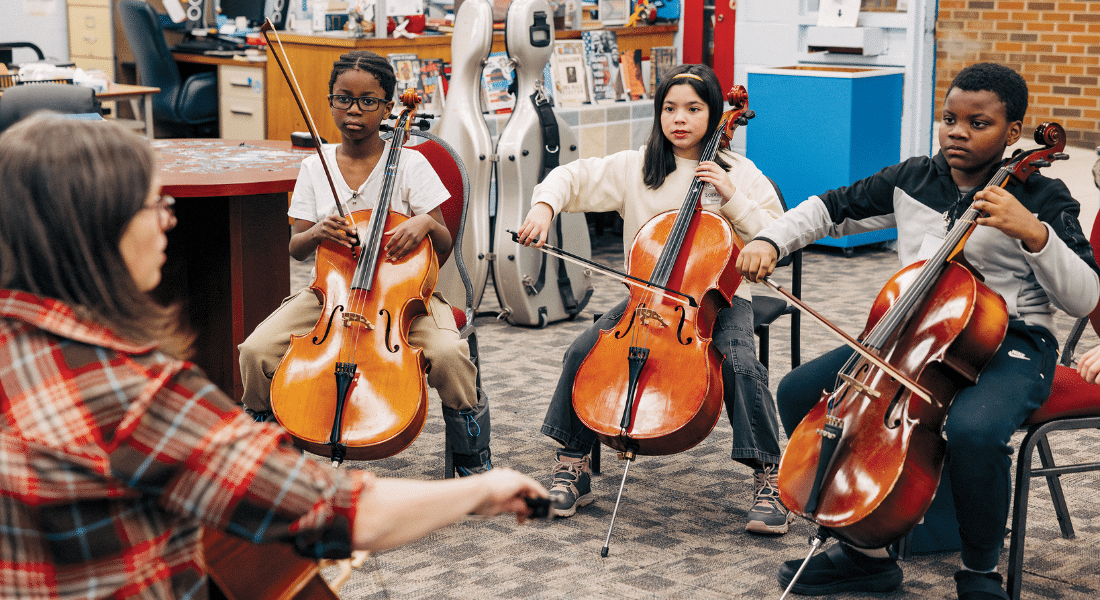
Jeremiah, Sophie and Tuntise (left to right) participate in weekly group cello lessons provided by OrKidstra.

Imagine dreaming of a career at the same time you’re struggling to pay rent or deal with childhood trauma. That’s the reality for many young people aging out of Canada’s child welfare system. At 18, these youth lose access to foster homes and social workers, leaving them to face an uncertain future, including barriers to furthering their education and pursuing a career.

To empower youth transitioning out of care, the Azrieli Foundation supports the Children’s Aid Foundation of Canada in providing scholarships and bursaries through its Post-Secondary Education (PSE) Program.

The Foundation has donated $1 million to the PSE Program since 2018. In the 2024–25 academic year alone, a $150,000 contribution provided 10 scholarships and 30 bursaries. The program supports full- and part-time students and connects them with resources that support their success.

“This funding serves as a reminder that I’m not alone,” says one PSE Program recipient. “That kind of support is really important because it lets me know that people see potential in me, and that there is so much I can accomplish because of it. I hope to one day go to law school, and work in Parliament. I want to one day help create systems that are fair, inclusive and understanding, by speaking up for those who are often ignored.” — Jaclyn Law

When music education is well supported, students learn to flourish.

Sign up to receive emails about the remarkable people and programs we support.

Subscribe to our newsletter