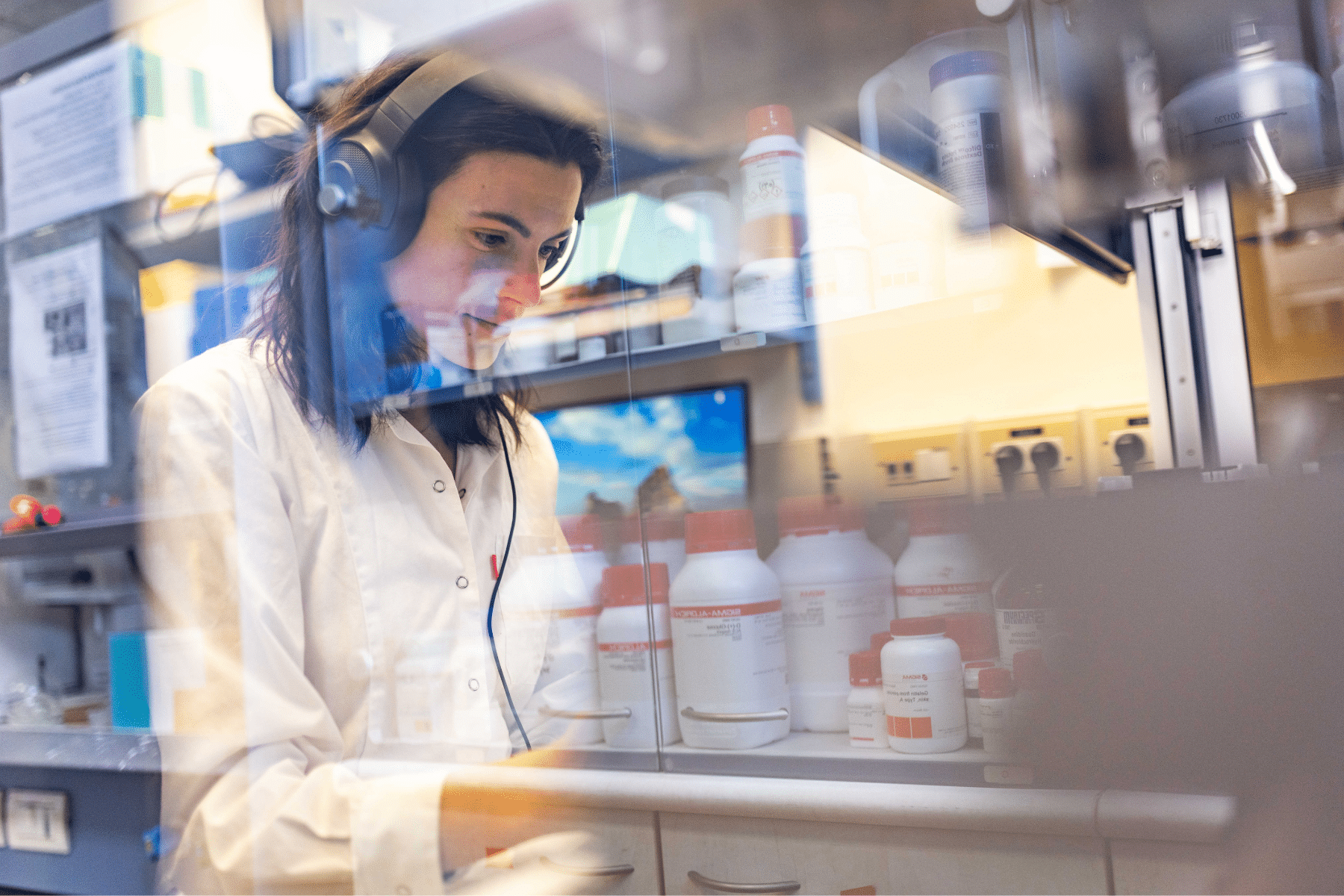
When Dr. Patricia Mora Raimundo first began exploring whether music could help improve drug delivery to the brain, the idea sounded almost impossible. It was ambitious, unconventional and rooted in a deeply personal question for her. Years later, that early concept has become a published scientific paper, an award-winning body of work and the foundation for a career that has moved in an exciting new direction.
This is, in many ways, a where-are-they-now story. In an earlier Aperio feature, “Orchestrating a Cure,” readers were introduced to Mora Raimundo’s fellowship project at an early stage, when the idea was just beginning to take shape. This story picks up where that one left off: with the results now published, the work gaining attention and Mora Raimundo following a path that shows what can happen when a fellowship does more than support a research project. Through the Azrieli Fellows Program, she was able to pursue a postdoctoral experience in Israel that shaped not only her science, but also her understanding of innovation and what it means to carry an idea beyond the page.
“I could never have imagined it would be that successful.”
The research at the heart of Dr. Mora Raimundo’s fellowship has now come full circle. Published in late 2025 in the Journal of Controlled Release, the paper, “Music enhances lipid nanoparticle brain delivery and mRNA
transfection in brain cells,” shared findings that were as striking as they were promising. In neuronal cultures, exposing cells to low-frequency sound, including music, led to a tenfold increase in gene expression compared with untreated cells. In pre-clinical models, audible low-frequency sound was associated with significantly higher mRNA expression in regions of the brain tied to sound processing and emotional regulation.
“It was amazing. It ended up being even more exciting than we thought,” Dr. Mora Raimundo says. “I could never have imagined it would be that successful.” For her, the excitement was not only about the results themselves. It was also about what they suggested: that music, used in a precise and carefully studied way, might one day help open new possibilities in brain medicine.
“I didn’t want the innovations I was bringing to the table to stay in a paper.”
Since then, Dr. Mora Raimundo has presented the work at international conferences and received the EuroTech Future Award 2024 First Prize, recognizing the broader framework behind the research: Music Input in Nanotechnology-based treatments for Neurological Disorders, or MINND. But one of the clearest signs of the project’s influence has come from what happened after she moved on. Even after transitioning out of that specific field, she continues to hear from researchers, students and companies interested in the work and where it might lead next.
That ongoing interest is part of what makes Dr. Mora Raimundo’s journey so compelling. Today, she works at a startup helping develop AI models that use medical data to predict diseases years before symptoms appear. Her work now focuses on preventive health, including identifying risks for conditions such as diabetes or colorectal cancer well in advance. It is a different field from the one she explored during her fellowship, but for Mora Raimundo, the throughline is clear: she is still driven by the same desire to see ideas make a tangible difference in people’s lives.
“The Azrieli Foundation provided that startup mindset.”
“I didn’t want the innovations I was bringing to the table to stay in a paper,” she shared. “I wanted to really see the impact an innovation can have.” That mindset grew stronger during her time in Israel, where she saw a culture of research that was deeply connected to real-world application. “I was really inspired by the Israeli way of thinking,” she says. “A lot of the time they do research with the end goal of building a product.”
For Mora Raimundo, that exposure changed everything. “The Azrieli Foundation provided that,” she reflected on her fellowship experience. “That startup mindset was something I had never experienced before going to Israel.” What she encountered was an environment where innovation moved quickly, promising ideas were not expected to remain theoretical forever and research frequently fueled startups.
That first project is still very much alive in another sense too. Dr. Mora Raimundo has been approached by others who want her perspective on related innovations, including companies exploring music-based health applications and researchers interested in using AI to identify the exact frequencies and sounds that may be most effective. For Mora Raimundo, that continued momentum is meaningful. “It’s nice to see that the work I did before still has that impact, that people are still contacting me because of it,” she says.
“Groundbreaking is the word.”
There is also, perhaps, something fitting about this story appearing in a newsletter themed around the healing power of music. Mora Raimundo’s research was never about music as metaphor alone. It asked what music could do in the body, in the brain and in medicine itself.
For the Azrieli Fellows Program, Dr. Mora Raimundo’s path is a powerful example of what support for early-career researchers can make possible: connect them to a broader ecosystem of mentorship, interdisciplinary collaboration and real-world application, helping them take their work further than they might otherwise imagine. In Patricia’s case, that support created space to test an unconventional idea, build international networks and gain exposure to a culture of innovation that continues to shape her career today. Her journey reflects a core belief behind the program: that when talented researchers are given the freedom, resources and perspective to think differently, their work can move beyond the lab to create meaningful impact in the world. A fellowship can help launch a project. Sometimes, it can also help launch a way of seeing the world. “Groundbreaking is the word,” she says. And in more ways than one, it is.