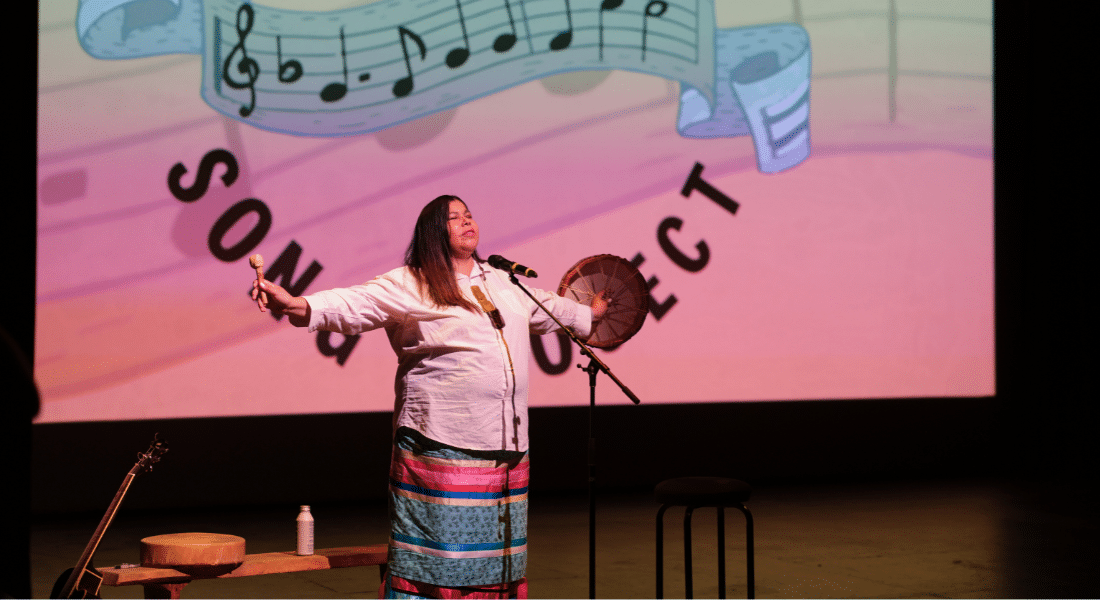
Before the first gathering takes place, before a young person sits across from an Elder and tries to follow a melody they have never been taught, there is a recognition at the centre of TO Live’s Indigenous Song Project: these songs were never meant to disappear.
For generations, Indigenous cultural knowledge in Canada was silenced through policies that prohibited people from speaking their languages, practicing ceremonies and singing traditional songs. What was disrupted was more than music. It was the transfer of knowledge, identity and connection from one generation to the next.
Now, through support from the Azrieli Foundation, TO Live is helping create space for that connection to return.
The Indigenous Song Project is a year-long pilot program unfolding across Ontario and Québec that brings Indigenous youth together with Elders, Knowledge Carriers and community members through cultural songs and shared learning. The initiative is rooted in relationship-building: songs are taught alongside stories, teachings and cultural context.
“The concept of intergenerational healing is just as real as intergenerational trauma,” Dawn T Maracle, Director of Indigenous Affairs and Engagement for TO Live. “Providing space for youth to reclaim their ancestral knowledge and community connections will inspire more creative works and collaborations.”
The project will unfold through three gatherings over the course of a year. Early events will feature performances from Indigenous artists and Knowledge Carriers, followed by workshops led by Indigenous music educators who will work directly with youth on traditional songs, instruments and musical styles. The program will conclude with a celebration at TO Live’s St. Lawrence Centre for the Arts, bringing participants together to honour the relationships and teachings built throughout the project.
The structure is intentionally community-led and relational. Diverse nations of Indigenous youth and singers will have the opportunity to engage with each other through performance, education and networking. Elders and Knowledge Carriers are compensated for their expertise and time. Cultural teachings are shared carefully and respectfully, recognizing that not every song or ceremony is meant for public performance.
These decisions reflect a broader shift in how cultural knowledge is valued and supported within Canada’s arts sector by the Azrieli Foundation. Through its Music, Arts and Culture Centre, the Foundation supports initiatives that expand access to the arts while strengthening inclusion, cultural connection and creative opportunity across Canada. In supporting TO Live’s work, the Foundation is helping organizations build programs that recognize artistic expression not only as performance, but as a source of identity, healing and belonging.
That same commitment to representation and access is reflected in TO Live’s BIPOC Production Mentorship Program, another initiative supported through the Foundation’s investment in arts and culture.
The multi-tiered program was created to address longstanding barriers to entry in the live entertainment and theatre production industry by providing BIPOC youth, students and early-career professionals with hands-on training, mentorship and paid opportunities behind the scenes.
Participants move through a structured pathway that begins with exposure to technical theatre careers in high school and extends into post-secondary internships and early-career placements within live productions. Along the way, they gain practical experience in lighting, audio, carpentry, stage operations, budgeting and production management while building professional networks within the industry.
Importantly, the program also creates opportunities for participants to learn from mentors who share their lived experiences. For many emerging artists and production professionals, that visibility can be transformative.
One participant described how shadowing TO Live’s production managers during a live festival changed the way they saw themselves within the industry. What began as an opportunity to develop technical skills evolved into something larger: confidence, professional identity and the ability to imagine a sustainable future in the arts.
Mentorship remains central to that work. Veteran lighting designer Arun Srinivasan, who has spent nearly 30 years working in the performing arts as a Canadian South Asian professional, sees the program as a way to challenge long-held perceptions that careers in the arts are unstable or inaccessible for many BIPOC communities.
Together, the TO Live’s Indigenous Song Project and the BIPOC Production Mentorship Program reflect a broader vision for what arts funding can make possible.
With support from the Azrieli Foundation, TO Live is creating artistic opportunities by helping to foster connection, diverse representation and long-term cultural resilience.
These programs are not simply about access to the arts. They are about building a cultural sector that is more inclusive, more connected and more reflective of the communities it serves, while building stronger relationships together.