
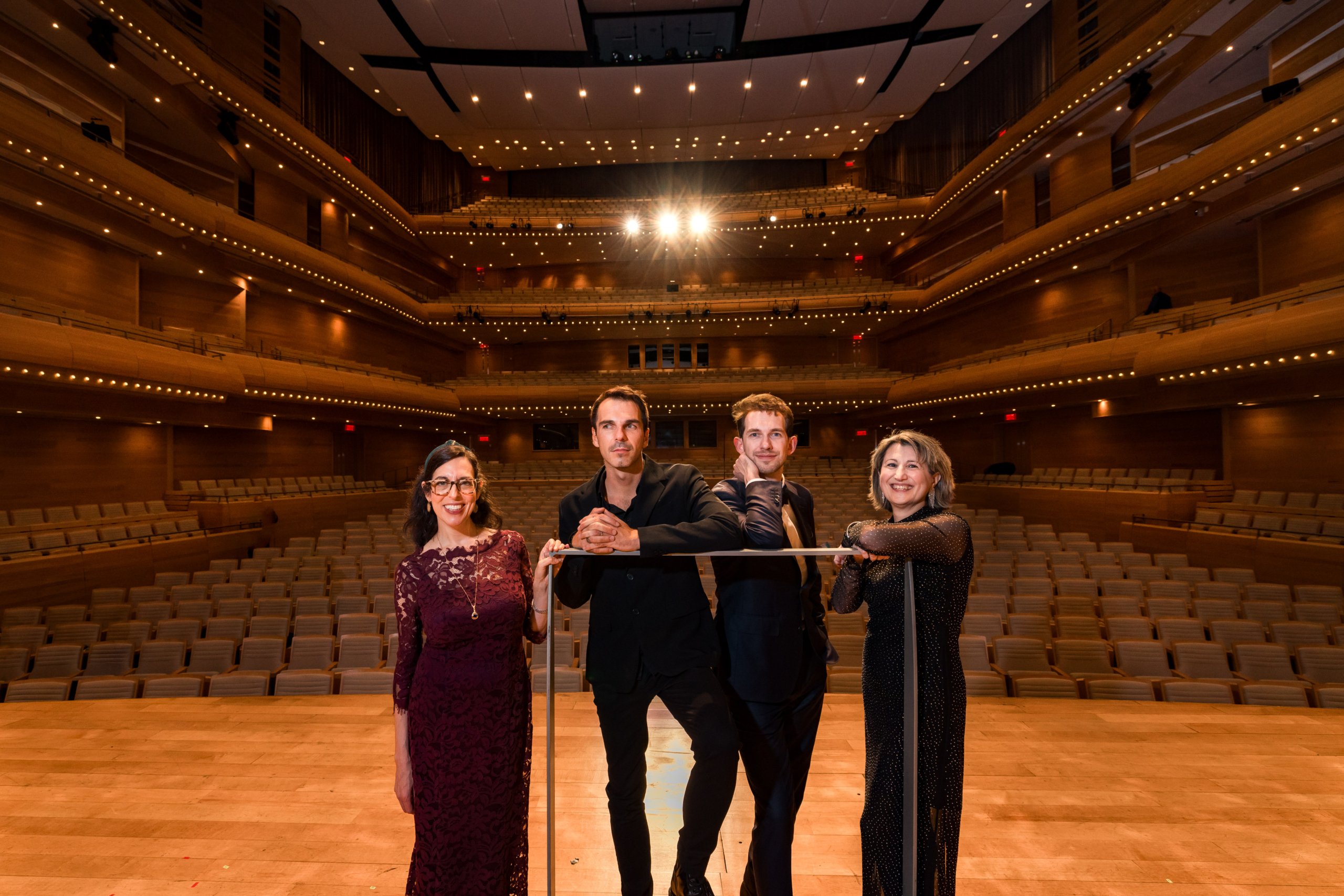
The Azrieli Music, Arts and Culture Centre (AMACC) proudly presented the 2026 Azrieli Music Prizes (AMP) Gala Concert on October 15, 2026, at the Maison symphonique de Montréal. The Gala celebrated four outstanding composers whose works explore identity, memory, cultural expression and our relationship to the world around us.
Created in 2014 by Sharon Azrieli C.Q., D.Mus for the Azrieli Foundation, the biennial Azrieli Music Prizes are among the most significant composition prizes in the world, supporting the discovery, creation, performance and celebration of excellence in music composition.
“When I first imagined the Prizes in 2013, I had a vision for a competition that would encourage composers to think deeply about music’s fundamental contributions to society,” said Sharon Azrieli, Chair of AMACC . “What started with two Jewish music prizes has grown into a rich catalogue of eighteen major works across four prizes that are now finding their way into performance catalogues around the world.”
The evening brought together artists, cultural leaders, supporters and music lovers from around the world, both in person and via livestream, to experience four powerful world premieres.
The evening opened with de l’encra escafada (“from faded ink”) by Romanian-Ukrainian composer Adrian Mocanu, recipient of the Azrieli Commission for International Music.
“The work is based on the text of a medieval trobairitz whose name was Beatriz de Dia,” said Mocanu. “I’m working with her poem and filtering it through a contemporary musical language.”
The work combined choir, orchestra and four violas da gambas in a haunting meditation on memory, language and cultural inheritance. For Mocanu, the work was also an act of preservation.
“For me, it is about reflection on our cultural legacy and keeping it alive,” he said. “I want the public to interact with this legacy.”
The second work on the program was Letter From Across the River by American composer, pianist and thereminist Dalit Hadass Warshaw, recipient of the Azrieli Commission for Jewish Music.
It depicted the true story of Warshaw’s great-grandfather, who swam across the Bug River from Nazi-occupied Poland to Soviet Ukraine to send a farewell letter to his sons before returning to face his fate alongside his family.
At the heart of the composition, she explained, was a deeply human conflict. “It was a choice between life and death, duty and freedom.” For Warshaw, receiving the commission allowed her to finally realize a project that had remained close to her heart for years.
“It was beyond encouragement and acknowledgement,” she said. “It was almost a blessing. You’re given this benediction from on high to pursue the dream project that you have.”
Following intermission, audiences became participants in Height of Land, a groundbreaking work by Canadian composer and cellist Nicholas Denton Protsack, recipient of the Azrieli Commission for Canadian Music.
Influenced by Canada’s watersheds and natural landscapes, the composition immersed listeners in an expansive sonic environment where audience members joined the performers in creating sound.
His work was informed by a belief that listening itself can be transformative.
“The orchestra is a landscape,” Denton Protsack said. “The audience is not merely a listener, but also a performer.”
Following the performance, Sharon Azrieli reflected on the unique experience shared between artists and audience.
“It created such a beautiful sense of collaboration between the musicians, the chorus and everyone in the hall,” she said. “It was a wonderful reminder that Canadian music can be rooted not only in landscape, but also in relationships between people, place and sound.”
The evening concluded with Riddle, the work that earned Georgian-Israeli composer Hana Ajiashvili the Azrieli Prize for Jewish Music.
Drawing upon a mysterious text by the 12th-century Jewish poet and philosopher Yehuda Halevi, the piece transformed medieval verse into a powerful reflection on persecution, resilience and hope. The work moved from darkness and tension toward an ending centered on a single Hebrew word: adam (“human”).
Researching the poem’s historical context led Ajiashvili to the persecutionJewish persecution. Yet, despite the darkness explored throughout the work, she sought to end with an affirmation of shared humanity.
“They pray for hope, for something light, for something good,” she said, describing the choir’s role in the composition’s closing section.
Ajiashvili described the Azrieli Music Prizes as a turning point in her career.
“It’s like a new chapter in my life as a musician and as a composer,” she said. “It opens new doors and new opportunities for my music. I hope my music will inspire people to do something good, to hope, to peace and to love.”
As the evening drew to a close, Sharon Azrieli reflected on the significance of presenting four world premieres in Montréal.
“Our first encounter with new music is a rare gift,” she said, “and it is one of the great joys of these prizes.”
The Gala marked not only the culmination of a two– year long creative process, but the beginning of each work’s life beyond the concert hall. Following their world premieres in Montréal, the four compositions will continue their journeys through future performances and recordings, ensuring these new musical voices reach audiences around the world.
Watch the concert: https://azrielifoundation.org/amp/gala/


