
Protected: Special Delivery

There is no excerpt because this is a protected post.

Photographs by Giannis Voulgarakis
October 14, 2026 By Alex Hutchinson
View PDF version

It happened fast. At a scientific conference in her home city of Athens in the fall of 2021, a young Greek researcher named Evgenia Mitsou heard a talk that fascinated her. It was an eagerly anticipated lecture by Jacob Klein, a world-renowned materials scientist at the Weizmann Institute of Science, whose discoveries about friction and biological lubrication had revolutionized the field.

Mitsou chatted with Klein after the talk about a postdoctoral position in his lab; he emailed a few hours later to say he would be in Athens until nine o’clock that evening — and would she like to meet before then to interview? The meeting went well, and two months later, she recalls with amazement, “I just packed my things and went to Israel.”

These days, Mitsou leads a team at the National Hellenic Research Foundation’s Institute of Chemical Biology, in Athens, focusing on the emerging field of nanotherapeutics — that is, the use of bespoke nanoparticles (particles up to 100 nanometres in diameter) to deliver medicines in new and efficient ways. Mitsou’s entire research career, dating back to her master’s and PhD work, has revolved around the use of nanoparticulate carriers to encapsulate and deliver antioxidants, vitamins and drugs wherever they’re needed in the body. But her three-year stint in Klein’s lab gave her a crucial insight: that the nanoparticle itself can have benefits, regardless of what’s inside it. “It can be active even without delivering anything,” she says. “And this was something I never imagined.”

New drugs are often hailed as breakthroughs, but figuring out how to deliver those drugs remains one of the central barriers to the successful rollout of new therapies. Mitsou’s collaboration with Klein is just one element of a broader mission to crack the problem of getting the right dose to the right place by tailoring the properties of the drug’s carrier. Mitsou even envisions a future where bespoke carriers will be optimized for individual patients.

“Researchers who can integrate nanotechnology with real biological challenges are contributing to the future direction of modern medicine,” says Aristotelis Xenakis, Mitsou’s colleague and former doctoral supervisor at the National Hellenic Research Foundation. “Evgenia is clearly part of this new generation.”

Share this article
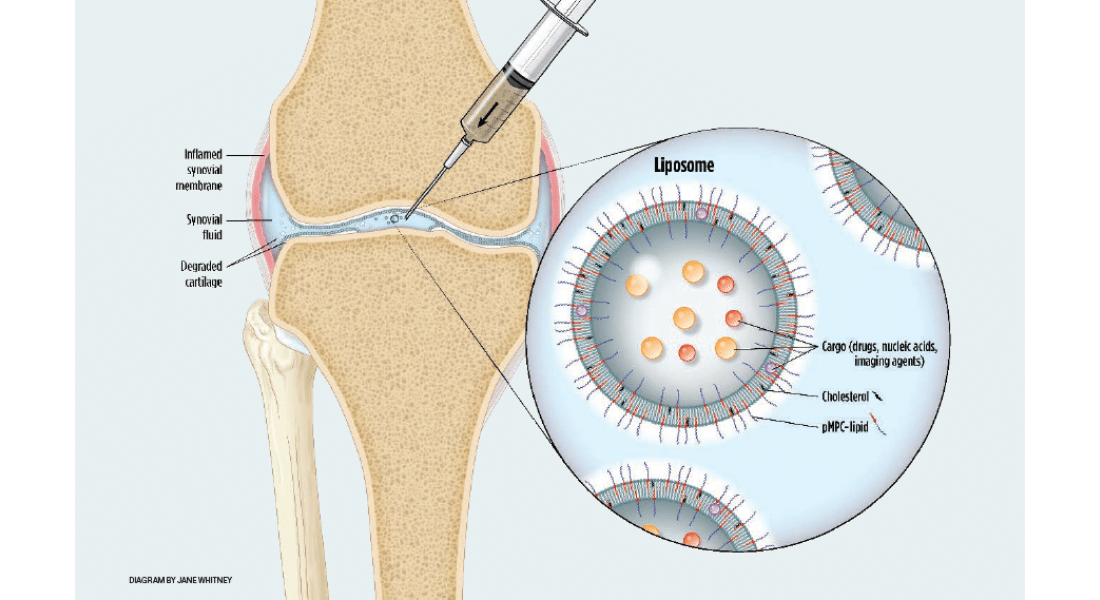
How to grease an arthritic knee: A knee injection sends nano-sized liposomes into joint fluid worn thin by inflammation and cartilage damage. Each liposome is a tiny fat-based bubble, stabilized by cholesterol and coated with “slippery” pMPC polymers that mimic the joint’s natural lubrication. Once inside, it carries a therapeutic cargo — drugs, genetic material or imaging agents — that’s released where it’s needed to restore smoother movement, ease pain and monitor joint disease.

As a child, Mitsou wanted to be a doctor. She eventually realized that the methodical, step-by-step process of scientific research suited her better than the chaos of real-time patient care. At the University of Ioannina, northwest of Athens, she enrolled in an integrated bachelor’s and master’s program in biology. Her master’s thesis explored encapsulating antioxidants in nanostructures.

Mitsou found the research interesting but wasn’t convinced her future lay in science. No one in her family had ever pursued a PhD, so it seemed like a big leap. She spent the year after finishing her master’s as a research associate, before finally deciding to embark on a PhD. After completing her PhD, Mitsou took another pause, teaching in both high school and university before deciding to go all-in on research. “In the beginning, it was curiosity,” she says, reflecting on what kept drawing her back. “I would find something, and slowly, slowly, I would try to understand what was going on. And this feeling just grew on me.”

By the time she joined Klein’s lab in Israel as an Azrieli International Postdoctoral Fellow, Mitsou had extensive experience encapsulating substances in very tiny packages. One project, now patented, involved making microemulsions based on olive oil to replace some of the trans fats in whipped cream. Another involved delivering nano-encapsulated anti-inflammatory drugs through the skin, figuring out how the structure of the nanocarrier affected its delivery.

And she was eager to find new ways to apply these ideas, which is why Klein’s talk at the conference in Athens made such an impression on her. “I was super fascinated because I was just putting drugs inside carriers, and he said, ‘Okay, you can use the carrier,’” she says. “This is where I fell in love with the topic.”

The study of friction and lubrication in biological systems may attract little attention, but it holds immense importance. Humans and other animals have weight-bearing joints with astonishingly low friction, far better than anyone has been able to engineer artificially. Even though we take thousands of steps every day, applying the equivalent of several body-weights’ worth of force to our knees and hips, these joints allow their respective bones to slide smoothly past each other — as long as they’re working properly.

Few nanotherapeutics make it out of clinical trials. To beat the odds, Mitsou focuses on optimizing liposome carriers for the individual rather than average patient.

Unfortunately, our joints don’t always work as well as they should. Osteoarthritis, in which the shock-absorbing cartilage in the joints degenerates, is one of the leading causes of disability around the world, afflicting some 600 million people. Knees, in particular, are a common problem area. Without the lubricating effects of healthy cartilage, Mitsou explains, the bones rubbing together in an arthritic knee joint are like rusty hinges creaking open and shut. It can be extraordinarily painful, but so far doctors have no effective treatments to stop or reverse the degeneration of the cartilage.

One commonly used therapy is injecting a substance called hyaluronic acid into the knee joint. It’s one of the naturally occurring molecules that acts as a lubricant in the fluid between the cartilage surfaces. Getting additional lubricant into the joint should effectively “oil the hinge,” reducing pain and slowing some of the wear and tear that causes the cartilage to degenerate further. But injecting hyaluronic acid isn’t effective, because it doesn’t stay in the knee joint for long. Some studies suggest that much of the perceived benefit may stem from placebo effects.

As an alternative to hyaluronic acid, scientists explored the use of liposomes, which are hollow nanoscale spheres of fat. But this idea, too, has plenty of challenges. For one thing, liposomes aren’t particularly stable, either on the shelf or in the body. The usual solution is to encase the liposome in a protective polymer called polyethylene glycol. But once that’s done, the liposome is no longer “slippery” enough to act as a lubricant.

An alternative solution Klein’s team pursued was to use a different polymer called pMPC to encase the liposome. This restored the liposome’s lubricant power and increased its staying time: when injected into the joints of mice, it lasted 100 times as long as hyaluronic acid.

The idea of using empty liposomes to lubricate knee joints is still moving toward commercialization. A spin-off company based on Klein’s research, called Liposphere, published a promising early clinical trial in 2024; a different liposome-based product developed by another Israeli company, Moebius Medical, completed a phase 2 clinical trial, with results published in 2025.

To Mitsou, though, there’s an even more tempting possibility, one that sits at the intersection of her PhD research in Greece and her postdoctoral work in Israel: inserting a drug inside the liposome, to combine its lubricative powers with the ability to deliver a therapy — an anti-inflammatory, a painkiller or a substance that helps cartilage regenerate, for example — directly to where it’s needed.

In 2025, Mitsou returned to the Institute of Chemical Biology in Athens, where she is now a principal investigator going through the laborious process of setting up her lab. Running her own group means more responsibility and administration, but she is determined not to let that keep her out of the lab. One thing she learned during the time she spent researching is that she’s most fulfilled when she has the opportunity to be creative, to work with her hands and to fulfill her curiosity.

Thanks to her scientific journey to date, Mitsou’s perspective on the future of nanotherapeutics has changed. “Before, I was focused on what to make and what to incorporate inside,” she says. “But now, I’m trying to figure out for whom I’m designing something.” This shift reflects an unfortunate reality: the landscape is littered with promising nanotherapeutic approaches that have failed to pan out in clinical trials. The problem, Mitsou believes, is that these therapies are usually designed and optimized for the average patient rather than individuals. When they fail, “it’s not a problem of the drug. It’s a problem of the carrier, which is not adapted to the individual being treated.”

“Researchers who can integrate nanotechnology with real biological challenges are contributing to the future direction of modern medicine. Evgenia is clearly part of this new generation.”

Consider a drug being administered intravenously to a 25-year-old versus a 75-year-old patient. They have the same disease, but the plasticity of their veins, for example, is completely different, raising concerns about whether ready-from-the-shelf liposomal formulations can perform equally well across different patients. If the drug is encapsulated in a liposome, then its mechanical properties — the stiffness or “slipperiness” of the carrier — might need to be tuned to achieve the same rate of absorption in both patients.

These are the sorts of challenges Mitsou hopes to tackle in her new lab, mastering the art of delivery. “I don’t synthesize drugs,” she says. “I know how to make a carrier.” She has an impressive array of sophisticated tools at her disposal to manipulate the properties of her carriers to adapt to whatever delivery problems a new therapy encounters, putting her at the forefront of an exciting new field. To Mitsou, it’s exactly the kind of puzzle that drew her to a research career in the first place.

“You give me a problem,” she says, “I’ll try to fix it.”

The Incredible Shrinking Pharmacy

At one point, the idea sounded fanciful: particles one-thousandth the size of a human hair, engineered to seek out diseased cells, deliver drugs with pinpoint precision and leave healthy tissue untouched.

Yet nanotherapeutics has moved well beyond the laboratory. Nanoparticles have been shown to protect fragile drugs from degradation, circulate through the bloodstream longer and release medicines in controlled ways that conventional pills or injections cannot.

Its most high-profile success came during the COVID-19 pandemic. Lipid-wrapped drugs proved themselves as a delivery system for mRNA vaccines, carrying fragile genetic instructions safely into human cells. That success has ignited efforts to apply the same platform to rare genetic diseases and autoimmune disorders, among others. Cancer treatment has been the other proving ground of nanotherapeutics.

Liposomal formulations of chemotherapy drugs, in particular, have been in clinical use for decades. They offer more targeted delivery to tumours compared to conventional options, while reducing toxic side effects of chemotherapy.

Theranostic nanoparticles are a new frontier merging diagnostics and therapy into a single platform. They’re designed to accumulate in diseased tissue, making them show up clearly on imaging tools like MRIs or CT scans. These same nanoparticles also carry drugs, which they release directly into cancer cells. Because they are both the diagnostic agent and treatment vehicle, theranostic nanoparticles can be used to track in real-time whether the medicine is reaching its target.

Yet significant obstacles remain. Many nanoparticle therapies that succeed in mice fail in humans. The safety and efficacy of nanotherapeutics can also be influenced by minor variations in various parameters — particle size, shape, surface charge — making manufacturing at scale extraordinarily difficult. Regulatory barriers are another reason many candidates fail to make it to real-world application.

The bottom line: fewer than 5 per cent of nanoscale therapeutics entering phase 1 clinical trials receive market approval.


Subscribe to our newsletter

* indicates required

All fields are mandatory.