For Brenda Blais, life with her daughter, Nikki, was filled with smiles, laughs and moments of pure joy. Born with complex disabilities that left her unable to walk or talk, Nikki needed full-time care for her entire 29 years. Still, Blais says she was the happiest person. “She radiated light and would capture anybody’s heart.”
Blais cared for Nikki until she passed away in 2022, surpassing doctors’ expectations for both the quality and length of her life. Although Blais never regretted a moment spent caring for her daughter, the all-consuming nature of the role often made her feel isolated and unseen.
Many caregivers across Canada experience similar challenges. According to CCCE’s 2024 Caring in Canada report, one in four caregivers has fair or poor mental health, and nearly half are feeling tired because of caregiving responsibilities.
Time for change
That lack of support is partly why the Azrieli Foundation created the Canadian Centre for Caregiving Excellence (CCCE). The program was launched in 2022 to support and amplify the voices of both care providers and unpaid caregivers, recognize the significant gaps they fill in the Canadian healthcare system, advance knowledge and foster collaboration in the field.
“A few years ago, we began asking a hard question at the Azrieli Foundation: If care touches every Canadian life, why does it remain so fragmented, so unsupported and frankly, so misunderstood,” says Naomi Azrieli, Chair of the Azrieli Foundation. “In creating CCCE, we saw a real opportunity to bring coherence, data and momentum to a field that was rich in compassion but lacking in structure.”
Helping drive that change is Liv Mendelsohn, CCCE’s Executive Director. Like Blais, she describes herself as a “lifelong caregiver” who has supported multiple family members and, living with a disability herself, received care, too. That perspective informs CCCE’s priorities, which include education and training, mental health supports, collaborating and more. Each element centres on the needs and experiences of caregivers, both professional and unpaid.
The power of advocacy
As part of its mandate, CCCE amplifies caregiver voices in its government advocacy, pushing for increased supports and formal recognition of the role they play in the Canadian healthcare system.
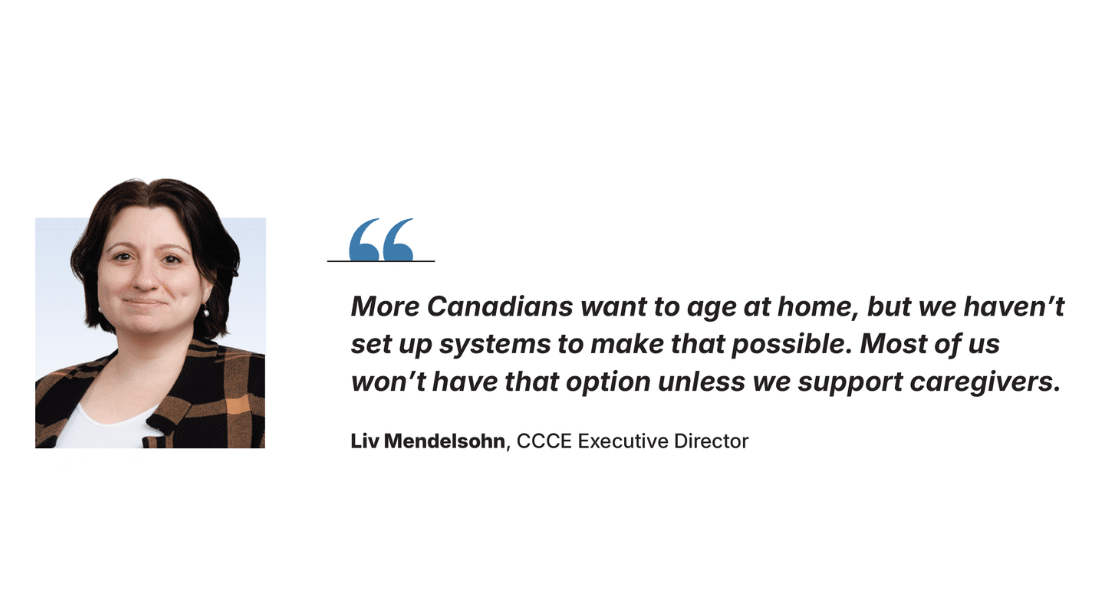
“We want to help caregivers understand their role and help decision-makers see what caregivers do and need,” Mendelsohn says, noting that 25 per cent of Canadians (and half of all women) are caregivers. “More Canadians want to age at home, but we haven’t set up systems to make that possible. Most of us won’t have that option unless we support caregivers.”
To address systemic hurdles, CCCE is advocating at the federal level to enact a National Caregiving Strategy, which it co-designed with caregivers and allies. The strategy would include financial and workplace supports for family caregivers, public policies to ensure a secure workforce of paid caregivers and the funding of services to improve caregivers’ well-being. It’s a strategy Blais wishes had been in place years ago.
“Due to Nikki’s intense needs, I had no choice but to leave my career and care for her 24-7,” Blais says. “As a result, I experienced the financial toll caregiving takes, including loss of income, benefits and long-term security.”
Leading the way
In addition to maintaining relationships with decision-makers, CCCE holds a biennial summit to bring together caregivers, care providers, systems leaders, government officials and researchers. James Janeiro, CCCE’s Director of Policy and Government Relations, says the more stories government representatives hear from the caregiving community, the more likely they are to understand the importance of a national strategy.
“The knowledge base among parliamentarians is significantly higher than it was when we first started,” Janeiro says. “As I talk to elected officials, they start to see that caregiving is also happening in their lives.”
Blais says she’s also seen government officials come on board after hearing about her struggle to find support while caring for Nikki. Today, she channels her passion for caregiving into her work as co-chair of the Canadian Caregiving Advisory Network, a national group of caregivers that provides input on CCCE’s projects and initiatives. She hopes that by continuing this work, she can help Canada get to a point where people like her won’t have to make the same personal sacrifices.
“We want caregivers to feel like they’re not alone anymore and that they’re valued in the system,” Blais says. “My daughter’s life was extended because of the care and love I provided. Caregivers are the backbone of the healthcare system, and they need recognition.”



 Brain trust