

The Bible’s Hidden History

How linguistic detective work is revealing the textual history of the Hebrew Bible

Photographs by Kris Snibbe
February 23, 2026 By Dan Falk
View PDF version

No book has captured the imagination as much as the Hebrew Bible. It is revered by believers, of course — but, even for secular readers, it is a remarkable work of narrative literature. For Jews, it’s a foundational text and cornerstone of their heritage. Yet many people don’t realize how much the Bible — and the language it was written in — has evolved over time.

“The Hebrew Bible is not a monolith and didn’t always look the way it looks now,” says Vladimir Olivero, a philologist who teaches Ancient Hebrew at Harvard University. “It was a product of many centuries of copying and using it. It was a text that was alive. Communities would adapt it to their needs. They were in dialogue with these texts.”

While the biblical authors may have been motivated by religious fervour, Olivero’s research is anchored in the down-to-earth world of texts and translations and languages. Much of his work involves dating specific passages in the Bible and other ancient texts. It may seem esoteric but has ramifications beyond the world of linguistics.

“This kind of analysis can help us better understand the history of ancient Israel,” Olivero says. “This is relevant for anyone interested in knowing more about the ancient world or, for those who are Jews, to know more about their roots and how ancient Israel developed across the centuries.”

Share this article

Olivero, who recently completed the Azrieli International Postdoctoral Fellowship at The Hebrew University of Jerusalem, was born and raised in Switzerland, where the number of spoken tongues was one factor that helped spark a fascination with language. An early interest in Greek and Latin made him more aware of how languages borrow from one another and how they evolve. In time, he turned his attention to Ancient Hebrew. But it’s tricky: There are very few surviving texts, and even those texts have a complex history.

“Probably the most important corpus [of Ancient Hebrew] is the Tanakh, or Hebrew Bible,” says Olivero. “But that’s difficult to date, because it’s a literary text that was copied across centuries, and we don’t have the so-called originals.” The earliest surviving biblical manuscripts are the Dead Sea Scrolls, discovered in the Qumran caves in the Judean Desert, southeast of Jerusalem, in the 1940s and ’50s; they date from between the third century BCE and the first century CE. Unfortunately, many of the scrolls are mere fragments.

“The Hebrew Bible was a fluid text, with scribes over the ages changing portions and adding or removing verses or passages. "The result is that everything is mixed up," says Olivero. "It's hard to identity the different linguistic layers."”

As well, later biblical texts are not straight-up duplicates of what’s in those earliest manuscripts. “The Hebrew Bible was a fluid text,” Olivero says. “Scribes changed many portions and added or removed verses and passages. The result is that everything is mixed up. It’s hard to identify the different linguistic layers.”

Hard, but not impossible. Much of Olivero’s research focuses on “textual criticism” — analyzing variants of specific passages and comparing them to translations seen in various languages over the centuries, in an effort to reconstruct the original text. But, as Olivero explains, even the notion of an “original text” may be problematic. Originals likely never existed because there were different editions of the same texts, he says. But there is a series of so-called “textual witnesses” — manuscripts and translations, including ancient translations, such as the one in Greek.

As an example, Olivero points to the Book of Jeremiah. There’s evidence that Jeremiah existed in at least two editions — an ancient one which had been translated into Greek, and a much later Hebrew version dating from the Middle Ages. “What’s interesting is that a fragment of a Hebrew manuscript containing Jeremiah Chapter 10 was found in Qumran, and it reflects the shorter text that you find in the Greek translation,” he says.

Olivero notes a similar situation with the Book of Samuel: There are fragments of the Dead Sea Scrolls that contain parts of Samuel that are closer to the Greek translation than to the medieval Hebrew texts. This suggests the Greek version is a closer reflection of the originals than the updated Hebrew version that reached us. And the Greek translations are just one resource; much can be gleaned from ancient translations into Syriac, Ethiopic, Aramaic and Latin. “If there are two forms of a text that differ from each other,” he says, “you can understand with a certain degree of certainty which one is earlier and which one is later.”

While biblical authors and translators are long gone, Olivero says, linguistic analysis offers a glimpse into what they were thinking and their response to cultural shifts.

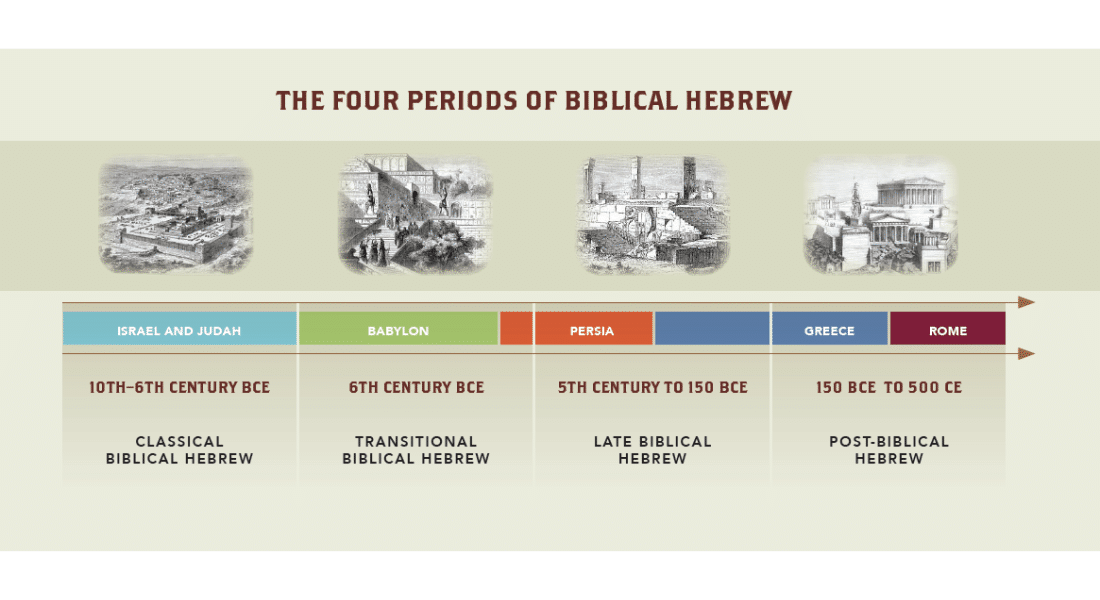
Sometimes “late” linguistic features stand out. A word or phrase associated with the period following the Babylonian exile (a 60-year period in the sixth century BCE), for example, can be found in a pre-exilic text. Such oddities turn up because of scribal activity, says Olivero. Scribes who intervened on an earlier text changed it for various reasons and left linguistic traces from their own period.

Sometimes the changes are not that profound: a word here, a phrase there. Occasionally, the changes reflect significant cultural shifts, Olivero says. After the exile, for example, there seems to have been a push to describe the deity in more reverential terms. “In Persian and Hellenistic times, there were concerns about how humans would relate to God, which were not there before the exile,” Olivero says. “Sometimes the Hebrew text is revised toward a more reverential way of approaching or describing the deity. So you don’t sin ‘against’ God, but you sin ‘before’ God. Or you don’t talk ‘to’ God, but you talk ‘before’ God. And that ‘before’ serves to separate you and the divinity.”

The change also reflects the dominant culture of the time — that of ancient Persia. In Persia, says Olivero, “you didn’t act ‘against’ or ‘to’ [the king]; you acted ‘before’ or ‘in the presence of.’ So you distance yourself, in a way, from the king or from God.”

For Olivero, understanding these linguistic changes, subtle as they may seem, helps illuminate a larger historical picture. “Once we have an idea of what came first and what came later, even within one chapter [of the Bible], that can help us reconstruct the social and cultural and religious history of ancient Israel.”

“Once we have an idea of what came first and what came later, even within one chapter [of the Bible], that can help us reconstruct the social and cultural and religious history of Ancient Israel.”

While Hebrew evolved over the eons, every language bears witness to such changes, says Noam Mizrahi, a linguist and philologist at The Hebrew University of Jerusalem, who supervised Olivero’s postdoctoral research. “Have you ever tried to read Beowulf in the original script? It’s completely unintelligible to any speaker of modern English,” Mizrahi says of the epic poem composed in Old English around the eighth century CE. “So within a thousand years, the English language changed to such a degree that it’s basically not recognizable by contemporary speakers of the language.” In spite of those changes, Beowulf is still seen as the foundation of English literature.

With the Hebrew Bible, time differences are even more substantial, with its earliest parts dating to around the 10th century BCE and its latest to about the second century BCE. Interestingly, modern Hebrew is not based on medieval Hebrew but rather on the Bible. “It was sort of a leap backwards,” says Mizrahi. “And the result is that modern speakers of Hebrew can still read the Hebrew Bible.”

For many people, these ancient accounts inform an appreciation for the historical accuracy of what is being described in the Bible. This has repercussions for relating textual descriptions to archaeological findings, and for debates about the history of ancient Israel and early Christianity, says Mizrahi. “So all of this is meaningful for a proper historical understanding of the ancient world at large.”

While it would be thrilling to jump in a time machine and zip back to the hills and deserts of ancient Israel, in practice it is evidence from archaeology and language that provides our clearest picture of how those people lived and what mattered to them. While the biblical authors, scribes and translators have been dead for many centuries, Olivero says, through linguistic analysis “you have a perception, a glimpse, into what they were thinking.”

Subscribe to our newsletter

* indicates required

All fields are mandatory.