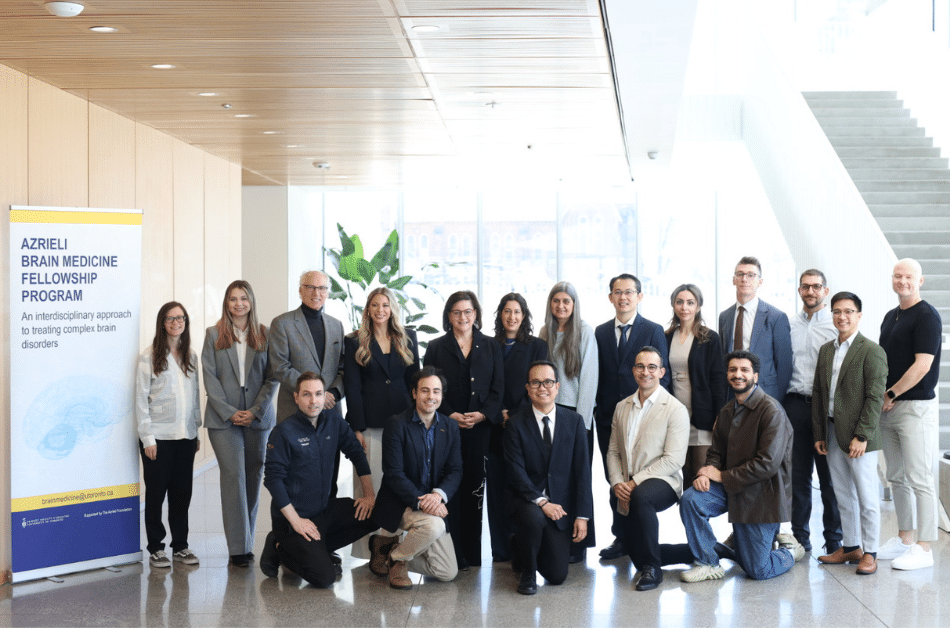
When clinicians, researchers, educators and trainees gathered in Toronto for the 3rd Annual Azrieli Brain Medicine Conference on May 8, the focus was bigger than a single day of presentations. It was a chance to see how a bold idea has taken hold: people living with complex brain disorders deserve care that is integrated, compassionate and reflects how brain-based conditions affect their lives. That vision is at the heart of the Azrieli Brain Medicine Fellowship Program, and increasingly, it is shaping the future of brain health care.
This year’s conference, themed Brain Medicine Across the Lifespan, reflected just how far the program has come. Hosted in partnership with the University of Toronto’s Temerty Faculty of Medicine, Sunnybrook Health Sciences Centre and University Health Network, the event brought together leaders from across disciplines to explore emerging therapies, precision diagnosis, education, research and clinical care from childhood through older age. The agenda spoke to the program’s momentum, with sessions spanning neurodevelopmental disorders, dementia care, women’s brain health and interdisciplinary clinical practice.
That momentum has been made possible through philanthropy. In opening remarks, Dr. Naomi Azrieli, Chair of the Azrieli Foundation, noted that the Foundation supports this work because it addresses one of the most urgent challenges in health care: the divide between specialties that patients experience as barriers to care. “Brain disorders do not respect silos,” she said. “Patients don’t arrive with tidy diagnoses or textbook symptoms. They arrive with complexity, uncertainty and often years of unanswered questions.”
The Azrieli Brain Medicine Fellowship Program was created in response to exactly that reality. Supported by the Azrieli Foundation, the program is training physicians to work across traditional specialty boundaries, bringing together perspectives from neurology, psychiatry, geriatrics, rehabilitation medicine and beyond. As the program has grown, so has its impact. Leadership shared updates at the conference on expanding fellowship opportunities, increasing recognition and strengthening the program’s role as a model for integrated care. Graduates are increasingly moving into academic and leadership settings, helping spread this approach across Canada and internationally.
The program is also expanding its reach across the lifespan. This year marked an important milestone with a new partnership with SickKids and the launch of a pediatric stream, extending brain medicine training into child and youth care. That growth reflects a broader understanding that brain health needs evolve over time, and that integrated care must be able to meet people where they are at every life stage.
The conference also underscored the intellectual and emotional force behind this work. The keynote address by Professor Adam Zeman explored the relationship between mind and brain through the study of memory and imagination, while also reflecting on his own long effort to challenge the divide between neurology and psychiatry. In a particularly moving moment at the close of his talk, Zeman became emotional as he spoke about how long he has been pushing for this kind of integrated thinking, and how inspired he was by the work of the Azrieli Brain Medicine Clinic. It was a powerful reminder that the effort to bridge these fields is not only academic, but deeply human. That message resonated throughout the day’s panels, workshops and case discussions, where participants examined what it takes to build truly interdisciplinary systems of care.
For the Azrieli Foundation, supporting brain medicine is part of a broader commitment to advancing brain health and improving quality of life for individuals and families. As Dr. Azrieli told attendees, “Better integration is not just an ideal, but a necessity for improving outcomes.” That belief is helping turn a promising concept into a growing field, one grounded in education, collaboration and patient-centred care.
The 3rd Annual Azrieli Brain Medicine Conference made clear that this is no longer an emerging conversation at the margins. Brain medicine is gaining traction as a practical, scalable response to the complexity of real-world care. And with sustained partnership, the Azrieli Brain Medicine Fellowship Program is helping lead the way.