Protected: The Invisible Frontier

There is no excerpt because this is a protected post.

Photographs by Kris Snibbe
October 14, 2026 By Elizabeth Howell and Alan Morantz
View PDF version

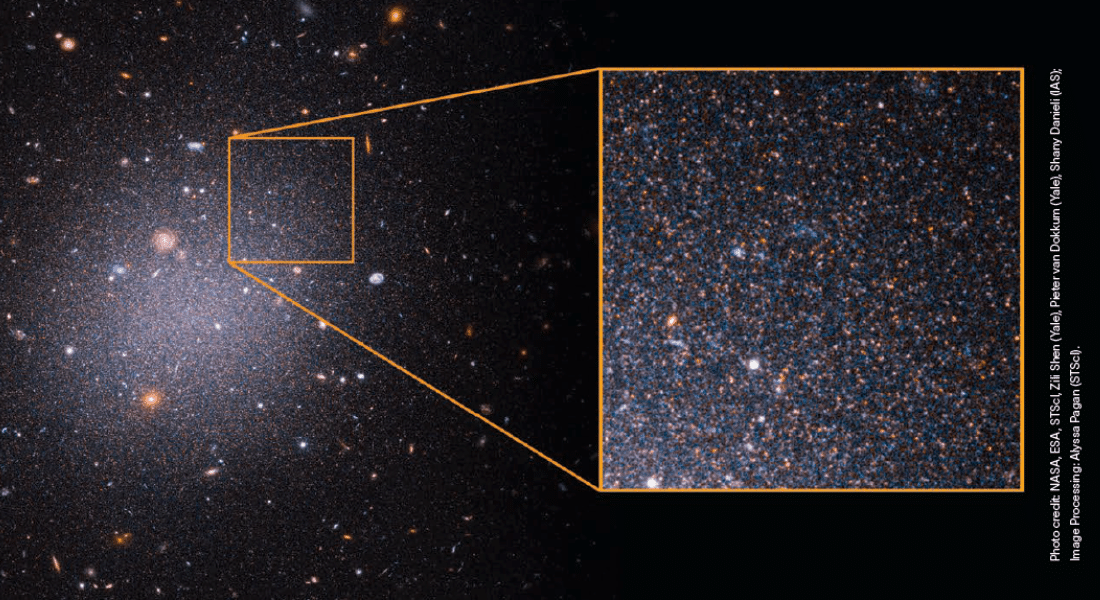
In 2018, a team of researchers co-led by astronomer Pieter van Dokkum of Yale University and Shany Danieli, at the time one of his graduate students, announced the discovery of a galaxy that appeared to contain almost no dark matter — the substance thought to provide the hidden scaffolding that allows galaxies to exist in the first place. The object, a dim and diffuse collection of stars known as NGC 1052-DF2, seemed impossible. The discovery of a similar galaxy, NGC 1052-DF4, soon followed.

Astrophysicists were flummoxed. If galaxies are supposed to form inside massive halos of dark matter, how could one survive without dark matter? Surely these cosmic oddities would eventually be explained away, and researchers could move on to areas of greater promise. In hindsight, though, the discoveries crystallized several major transitions in thinking already underway in the field.

For decades, astronomy focused on the bright and spectacular: giant galaxies, exploding stars, quasars, black holes. But new generations of telescopes and computing systems are opening a different frontier — one dominated by the faintest of structures, enormous datasets and lowsurface-brightness “dwarf ” galaxies like those co-discovered by Danieli.

Now an assistant professor at Tel Aviv University and an Azrieli Early Career Faculty Fellow, Danieli finds herself in the middle of this action. Her work stretches far beyond the original discoveries that first made headlines. Today, she leads sprawling observational surveys, uses some of the world’s most advanced telescopes and builds knowledge about galaxies so faint they were effectively invisible to astronomers only a decade ago.
Share this article
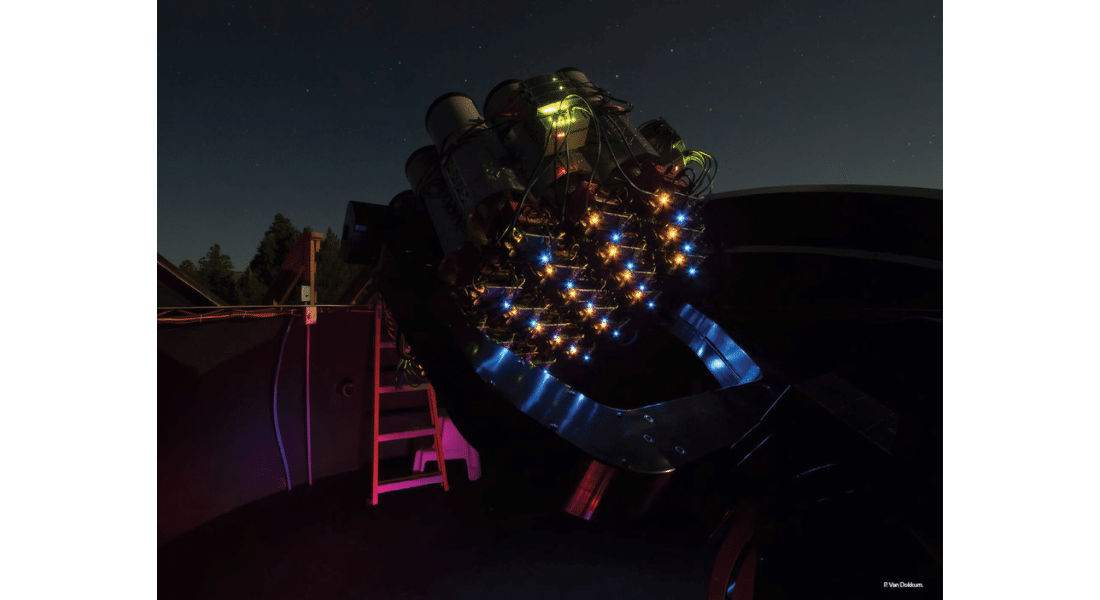
Offering a multi-barrelled view of the night sky, the Dragonfly Telephoto Array uses dozens of off-the-shelf telephoto lenses instead of conventional mirrors to capture extraordinarily faint objects in the night sky. Working together, the lenses are designed to suppress scattered light that overwhelms the delicate glow from diffuse galaxies — ghostly systems whose stars are spread so thinly they are difficult to make out. Using Dragonfly, Danieli led large-area surveys to identify these faint galaxies.

Danieli’s fascination with astronomy began long before her graduate work at Yale. Growing up in Israel, she was captivated by the biggest questions science could ask: how the universe began, how galaxies formed and what invisible forces shape the cosmos. Her high school lacked the advanced physics textbooks she wanted, so she persuaded her mother to buy one and began teaching herself.

“I always loved sciences in general,” she says. “I was also drawn to astronomy because it really asks — and sometimes gives answers to — some of the most fundamental questions we have in physics and generally in the universe.” After earning a bachelor’s degree at Tel Aviv University, she moved to New Haven for graduate school at Yale, completing her PhD in physics in 2020. There, her scientific instincts converged with a revolutionary observational tool: the Dragonfly Telephoto Array.

Developed by researchers at Yale and the University of Toronto, Dragonfly was designed specifically to detect faint, low-surface-brightness structures that ordinary telescopes often miss. Traditional telescopes struggled because scattered light inside telescope optics overwhelmed the delicate glow from diffuse galaxies. Instead of relying on a single giant mirror, Dragonfly combines many commercial telephoto lenses engineered to suppress scattered light.

It was just the tool to help Danieli study “dwarf ” galaxies — sprawling systems containing relatively few stars spread across enormous distances — which look like pale smudges rather than the bright spirals most people associate with galaxies. Using Dragonfly, Danieli led largearea surveys to identify these faint galaxies. “It’s kind of like finding hidden islands in an ocean,” she says. “We can cover a large area of the sky very quickly and find candidate objects that look unusual or especially interesting. Then we need to go back and study them in detail to understand what’s really happening.”

“For decades, astronomy focused on spectacular phenomena like giant galaxies and exploding stars. But the most advanced telescopes and computing systems open a new frontier dominated by faint structures and huge datasets.”

Often, the focus of study is dark matter. Astronomers figure dark matter makes up 85 per cent of all matter in the universe, yet it remains one of science’s greatest mysteries. Scientists infer its existence through gravity, yet nobody knows what it actually is. Dark matter is also important because it helped shape the universe after the “big bang” – the event believed to have created the universe – possibly acting like a giant framework around which matter gathered to form galaxies and within them, stars and planets. Understanding the nature of dark matter could lead to major discoveries about the basic laws of physics and how the cosmos works.

For decades, researchers studying dark matter concentrated largely on giant galaxies and particle-physics experiments in the search for answers. Increasingly, however, dwarf galaxies are becoming central to the investigation. For one, they are small, simple systems in which dark matter often dominates everything else, unlike large galaxies like the Milky Way that contain enormous numbers of stars, gas clouds and black holes. Dwarf galaxies are also thought to be among the oldest and least evolved galaxies in the universe. Many formed early in cosmic history and have changed relatively little over billions of years.

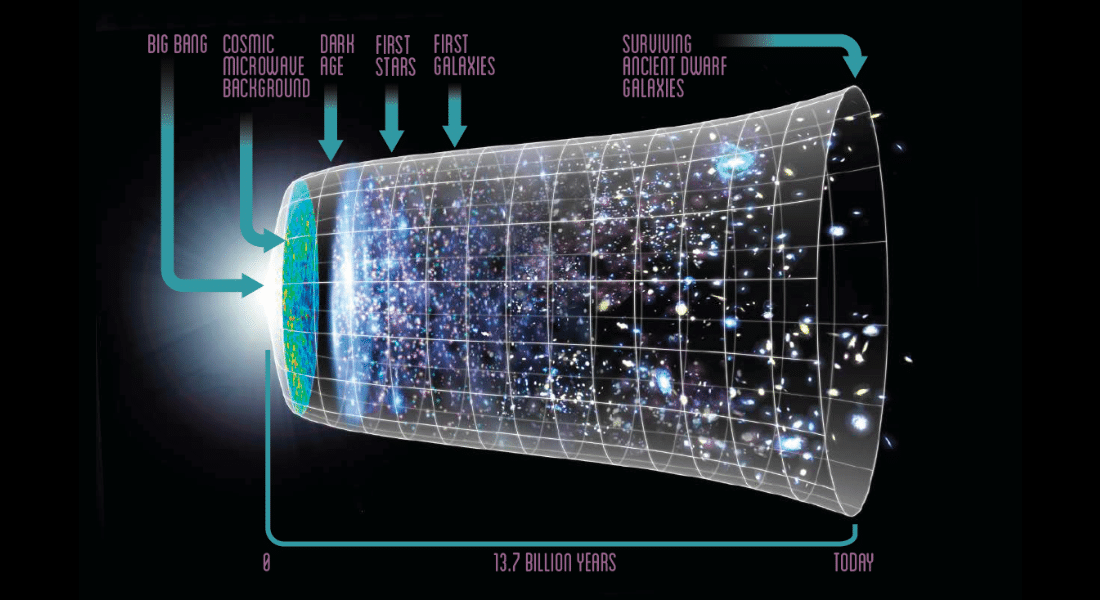
A timeline traces the universe’s expansion from the big bang, through the afterglow captured in the cosmic microwave background, into the dark ages before the first stars ignited and seeded the earliest galaxies. Today’s night sky holds living witnesses to that early epoch — dwarf galaxies that offer a window into the universe’s formative years.

“These are systems that preserve information about very early times,” Danieli says. “Because they formed so early and evolved relatively simply, they provide a unique window into the processes that shaped the universe.” She adds: “Not only are they interesting in the context of dark matter as we see it today, but they also teach us a lot about how the universe started in the first place. We can think about it as archaeological research.”

Danieli’s current research agenda has expanded from the original discovery of NGC 1052-DF2 and NGC 1052-DF4 — a development that helped scientists test competing ideas about galaxy formation and the true nature of dark matter. She now focuses on several related areas: studying how dwarf galaxies form and evolve, mapping the relationship between visible matter and dark matter and testing whether dark-matter-free galaxies can naturally emerge through collisions or other interactions.

Pieter van Dokkum has followed Danieli’s journey and is impressed. He says her work has already made her one of the leading young researchers in astrophysics, earning major recognition and research support early in her career.

Indeed, Danieli was a NASA Hubble Fellow and a Carnegie-Princeton Fellow before returning to Tel Aviv. She also holds research grants from both the Israel Science Foundation and the European Research Council, the latter a marquee award that signals she’s running a major independent program. Her research has been cited more than 4,600 times.

Jenny Greene, a professor of astrophysical sciences at Princeton University, is an influential observational astrophysicist and one of the foremost experts on the connection between galaxies and the black holes they host. She says Danieli already holds an important position in the field. “Professor Danieli is a recognized leader in the study of low-mass galaxies and how they occupy dark matter halos,” says Greene. “She’s been leading work investigating how dense star clusters and their spatial position within galaxies can be a sensitive test of the shape of dark matter halos. Now, she’s finalizing a review of everything the field has learned about these very diffuse galaxies we have really just discovered in the past decade.” Greene, who has collaborated with Danieli at Princeton and elsewhere, has also observed the seriousness with which she approaches her research.

“One thing I love about working with Shany is that she always pushes to make the project as ambitious as possible,” says Greene. “She’s never afraid to ask for large allocations of telescope time or resources to do her best science, and the results prove this is a good approach.”

Danieli is using the world’s most powerful telescopes to push deeper into the history of the cosmos. She’s now studying how dwarf galaxies form and evolve, mapping the relationship between visible matter and dark matter and testing whether galaxies without dark matter emerge through collisions or other interactions.
“One of the beautiful things about astronomy is that it places humanity in a broader perspective. The search to understand the universe is bigger than politics, borders or any single generation.”

A generation ago, astronomers typically studied galaxies in isolation. Today, they increasingly depend on gigantic collaborative surveys that catalogue millions of objects simultaneously and that incorporate observations, simulations and statistical analysis. Rather than relying on a few dramatic discoveries, researchers now aim to build enormous datasets capable of testing fundamental physics with unprecedented precision. Two major observational programs Danieli now helps lead — the ELVES and Merian surveys — are prime examples.

ELVES studies the tiny galaxies that orbit larger galaxies similar to our own Milky Way. Its goal is to understand what dwarf galaxies look like and how they behave beyond our local environment. The survey is already providing important new insights.

“ELVES has changed the way we study our cosmic neighbourhood,” says Danieli. “Instead of trying to understand galaxy formation from a single example, the Milky Way and its companions, we can now compare dozens of nearby galaxy systems. That broader view is revealing how the smallest galaxies form, evolve and connect to the invisible dark matter that helps shape the universe.”

Cosmic oddity: NGC 1052-DF2, an ultra-diffuse galaxy 72 million light-years away discovered by Danieli and Pieter van Dokkum, upended assumptions about dark matter. Danieli’s work on its distance and stellar populations helped confirm what first looked like an observational fluke: a galaxy with little to no dark matter.

The findings so far, for example, suggest that small galaxies almost always live inside much larger halos of dark matter and that the number of stars a dwarf galaxy forms is strongly connected to the mass of its dark matter halo. The process that turns gas into stars becomes increasingly fragile and inefficient in small galaxies, which explains the preponderance of dwarf systems that contain far more dark matter than visible matter.

Merian represents an even larger leap into the era of data-intensive astronomy. Using the Dark Energy Camera in Chile, it’s designed to identify and characterize tens of thousands of faint dwarf galaxies across vast regions of the sky. The survey uses specially engineered filters to detect subtle signatures of star formation and measure the relationships between visible galaxies and the invisible dark matter halos surrounding them.

The scale of the project reflects where astrophysics is heading. Over the next decade, observatories such as the Vera C. Rubin Observatory and the Nancy Grace Roman Space Telescope are expected to produce unprecedented maps of the night sky, generating torrents of data on faint galaxies, stellar streams and dark matter structures. Astronomers anticipate discovering millions of previously unseen dwarf galaxies. Meanwhile, NASA’s James Webb Space Telescope and future space telescopes will peer more deeply into cosmic history than ever before.

Danieli is part of this exploration as well, leading a newly awarded program with the Webb telescope aimed at one of the biggest puzzles in galaxy evolution. Astronomers have long assumed that the smallest galaxies can keep forming stars indefinitely unless something external shuts them down. Yet recent discoveries suggest many tiny galaxies stop forming stars entirely, even when left alone. By studying these cosmic holdouts in unprecedented detail, Danieli hopes to uncover when they shut down, why it happened and what their histories reveal about the forces that shaped the early universe.

For her, the excitement lies partly in how much remains unknown. Astronomers still don’t understand why some galaxies stop forming stars while others continue for billions of years. We don’t know precisely how dark matter behaves on small scales. And we can’t fully explain how black holes influence dwarf galaxies or whether tiny primordial galaxies seeded larger cosmic structures.

The faint systems Danieli studies may help answer those questions. To her, it’s the type of scientific inquiry that fits the time in which we live. “I’m deeply grateful to have the freedom to pursue independent ideas, take scientific risks and contribute to our collective understanding of the universe,” she says. “One of the beautiful things about astronomy is that it places humanity in a broader perspective. The search to understand the universe is bigger than politics, borders or any single generation.”


Subscribe to our newsletter

* indicates required

All fields are mandatory.