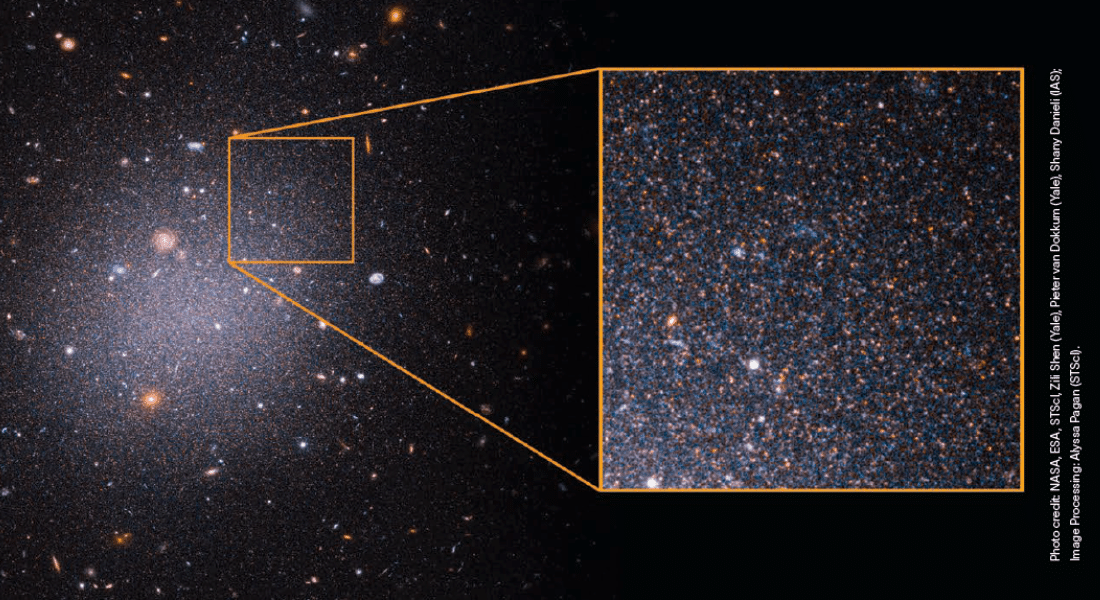
In 2018, a team of researchers co-led by astronomer Pieter van Dokkum of Yale University and Shany Danieli, at the time one of his graduate students, announced the discovery of a galaxy that appeared to contain almost no dark matter — the substance thought to provide the hidden scaffolding that allows galaxies to exist in the first place. The object, a dim and diffuse collection of stars known as NGC 1052-DF2, seemed impossible. The discovery of a similar galaxy, NGC 1052-DF4, soon followed.
Astrophysicists were flummoxed. If galaxies are supposed to form inside massive halos of dark matter, how could one survive without dark matter? Surely these cosmic oddities would eventually be explained away, and researchers could move on to areas of greater promise. In hindsight, though, the discoveries crystallized several major transitions in thinking already underway in the field.
For decades, astronomy focused on the bright and spectacular: giant galaxies, exploding stars, quasars, black holes. But new generations of telescopes and computing systems are opening a different frontier — one dominated by the faintest of structures, enormous datasets and lowsurface-brightness “dwarf ” galaxies like those co-discovered by Danieli.
Now an assistant professor at Tel Aviv University and an Azrieli Early Career Faculty Fellow, Danieli finds herself in the middle of this action. Her work stretches far beyond the original discoveries that first made headlines. Today, she leads sprawling observational surveys, uses some of the world’s most advanced telescopes and builds knowledge about galaxies so faint they were effectively invisible to astronomers only a decade ago.