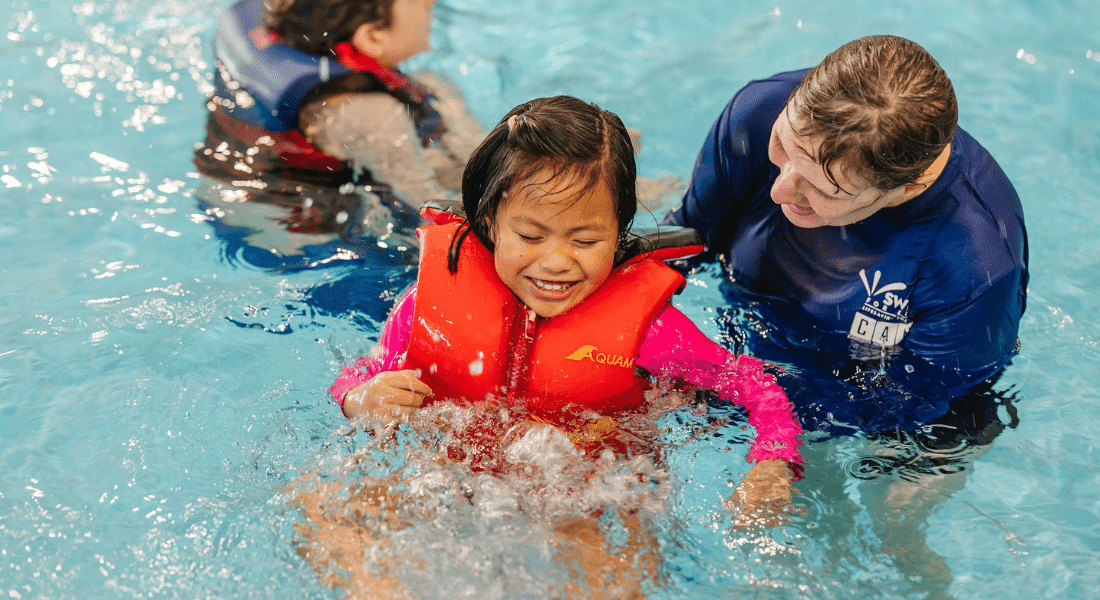
After Elliot’s first adaptive swimming lesson in Whitehorse, his mother, Jasmine, heard four words she had been waiting a long time to hear: “Mom, I had fun.”
For many children those words sound ordinary, but for nine-year-old Elliot, they carried enormous meaning. Elliot is bright, curious and, as Jasmine describes it, tenacious in the way he approaches the world. But traditional swimming lessons were overwhelming because he learns and processes information differently.
Elliot wanted to learn to swim and Jasmine wanted that for him too. Not just because swimming can bring confidence, independence and recreation, but also because water safety is critical. Yet lesson after lesson, she watched him work hard in an environment that was not designed for the way he learns.
At that point, Jasmine admits she was feeling exhausted. Like many parents of children with disabilities or developmental differences, she had spent years advocating for her son across systems, translating his needs from one setting to the next and trying to build individualized supports wherever he went. Swimming was no different, except that this time, she was not sure how to adapt to a pool environment on her own.
Then she reached out to the City of Whitehorse. They enthusiastically welcomed Elliot to try their adaptive aquatics program, which offered a quieter environment, smaller groups, slower pacing and individualized support. The team was still learning and refining the program, but the response Jasmine received carried something she had not always experienced: anticipation.
“There was all of a sudden an organization that said, yes, we recognize your son,” Jasmine said. “We recognize that he has different needs. And we have created a program to support him.”
For Jasmine, that mattered before Elliot even entered the pool. It meant she and her son were not arriving as a problem to be solved. They were arriving as members of the community who had already been considered. “All of a sudden, it felt like we were a part of community. We weren’t an inconvenience.”
During Elliot’s first lesson, the change was immediate. Instead of holding back, he charged into the pool and began trying activities he had not done before.
“What stood out most to me was that Elliot himself had not changed, the environment had,” Jasmine wrote in a moving email to the Whitehorse aquatics team. “The program design shifted in a way that allowed him to access learning, confidence and enjoyment.”
That shift is exactly what Canucks Autism Network and Lifesaving Society BC & Yukon hoped to make possible through the Adapted Swimmer training, a multi-year project supported by the Azrieli Foundation, that covers sensory considerations, visual supports and cues, communication strategies and practical approaches instructors can apply in the pool for autistic and neurodivergent swimmers.
For Stephanie Jull, Vice President of Programs, Training and Community Engagement at Canucks Autism Network, the project is rooted in the belief that community spaces should be designed so autistic people are understood, accepted and supported.
“There are so many good people in the community who want that exact thing for autistic people and their families. They want to create those spaces. They just need tools,” Stephanie said.
Those tools matter because inclusion cannot depend on one unusually committed instructor, one particularly resourced parent or one family’s ability to advocate over and over again. It has to be built into the system. The Azrieli Foundation supports organizations to incorporate inclusion into every aspect of their communities.
“We believe inclusion should be built in, not added as an afterthought,” says Orly Fruchter, Manager, Neurodiverse Initiatives at the Azrieli Foundation. “Supporting projects like this helps ensure more children and families can participate, belong and succeed.”
The Adapted Swimmer training was created to do just that. Canucks Autism Network and Lifesaving Society BC & Yukon were able to develop, test, pilot and refine the training, then embed it into a broader instructor pathway so it could reach more communities rather than sit unused on a shelf.
The training has rolled out in Surrey, Vancouver, Mission and Whitehorse, with additional implementations in Alberta, Quebec and Nova Scotia, and more planned across Canada in 2027-2028. The team aims to train provincial instructors to deliver the course, with the first phase of the BC rollout including the 2026 instructor recertification cycle and a goal of training 15,000 instructors across BC and Yukon by the end of 2027.
In Whitehorse, that national vision was not abstract for Elliot and Jasmine. It showed up in the way the instructors approached Elliot. It showed up in the quiet water, the small group, the extra time and the step-by-step instruction. It showed up in the feeling that Elliot belonged before he had to prove anything.
“When a program anticipates that children learn differently and is designed accordingly, they don’t just participate,” Jasmine said. “They know they belong.”
And the ripple effects extend far beyond one child, one family or one pool. Stephanie thinks often about the young swim instructors who will carry these skills with them long after their time on the pool deck. They become teachers, occupational therapists, dentists, business leaders or lawyers. Wherever they go, they bring a deeper understanding of how to support autistic and neurodivergent people into that environment, wherever it may be.
“By creating these experiences where people get information, feel really empowered, feel really confident and then take it forward,” Stephanie said. “This is how we change the world.”
*Pseudonyms used to protect the family’s privacy.