For many people, going to a concert begins with anticipation: the hush before the first note, the feeling of being surrounded by others, the pleasure of seeing live music unfold in real time. For others, that same experience can begin with a long list of questions. Will there be enough space? Will I be able to access the washroom? Will other concertgoers and staff understand if someone needs to move, vocalize, stand or lie down? Will a moment of joy be mistaken for disruption?
Those questions are at the heart of Xenia Concerts, a Toronto-based organization that creates inclusive, accessible concert experiences for neurodivergent, disabled and Deaf audiences, along with their families, caregivers and communities. The organization’s name comes from a Greek word connected to the practice of welcoming people into your home or community. For Xenia, welcome is not a sentiment. It is a design principle.
“People can come in and just be ourselves.”
That is how Rory McLeod, Xenia’s Executive and Artistic Director, describes the goal. Since joining the organization in 2021, Rory has helped build on a model that began nearly a decade earlier, when members of the Cecilia String Quartet were moved by an autism-friendly concert in California and set out to bring a similar experience to Canadian audiences. From the beginning, Xenia’s approach has been shaped through consultation with caregivers, healthcare professionals, occupational therapists, music therapists and people with lived experience.
The Azrieli Foundation began supporting Xenia’s work in 2023 – a particularly meaningful time, as the organization was growing its partnerships, strengthening its model and beginning to examine more deeply what its concerts make possible beyond the performance itself.
That examination became the focus of a research partnership with Toronto Metropolitan University’s Canada Excellence Research Chair in Health Equity and Community Wellbeing. The resulting report by Eun Jung, Eshtar Taha, and Mikyung Lee, From Access to Wellbeing: Framework Development and Health Impact Evaluation of Attending Inclusive Performative Arts Events, gave Xenia something both practical and powerful: a clearer way to understand, describe and strengthen the impact of accessible performing arts.
“It’s not just a way to communicate the impact of our programming,” Rory says. “It’s also a way for us to examine the way that we collect feedback, what parts of that conversation we might be missing and to fill in some of those gaps.”
The report looked at more than individual enjoyment. One of its most important conclusions, Rory says, was that inclusive concerts can affect people at multiple levels: individual, family, community and societal. A concert can give someone a joyful afternoon. It can ease the stress of a caregiver. It can create new forms of belonging. But it can also shift expectations in arts spaces and give partner organizations a framework for reaching communities they may not have known how to welcome before.
For Xenia, the report has become a tool for learning and sharing. It has already informed changes to feedback forms, helping the organization gather more complete information about who is attending and how they are benefiting. It has also become a touchpoint with partners across Canada, offering concrete evidence that accessible programming is not a niche add-on but a model with wide-reaching value. For the Azrieli Foundation, this aligns with its broader commitment to support accessible programs and music initiatives that help more people participate fully in community life.
“This is solid evidence of the value of this style of programming.”
That evidence matters because, too often, the barriers that families face are invisible until they become impossible to ignore. Lorena Sinato knows this well. Her son Bryan is legally blind, autistic and has complex medical needs. He loves music, and for Lorena, bringing him to concerts has always felt important. But traditional venues can turn that simple wish into a stressful calculation.
She remembers attending a musical at a large venue where the seating was difficult, the washroom access was limited and, when Bryan moved his body in response to the music, a staff member told her he needed to stop. “That’s his way of dancing and showing that he’s happy,” Lorena says. “My son was not doing anything wrong.”
The experience stayed with her. It also made the difference at Xenia even more meaningful.
“From the beginning of the outing to the end, I don’t have that stress,” she says. “Everybody’s welcome. Nobody’s judging. That is accessibility.”
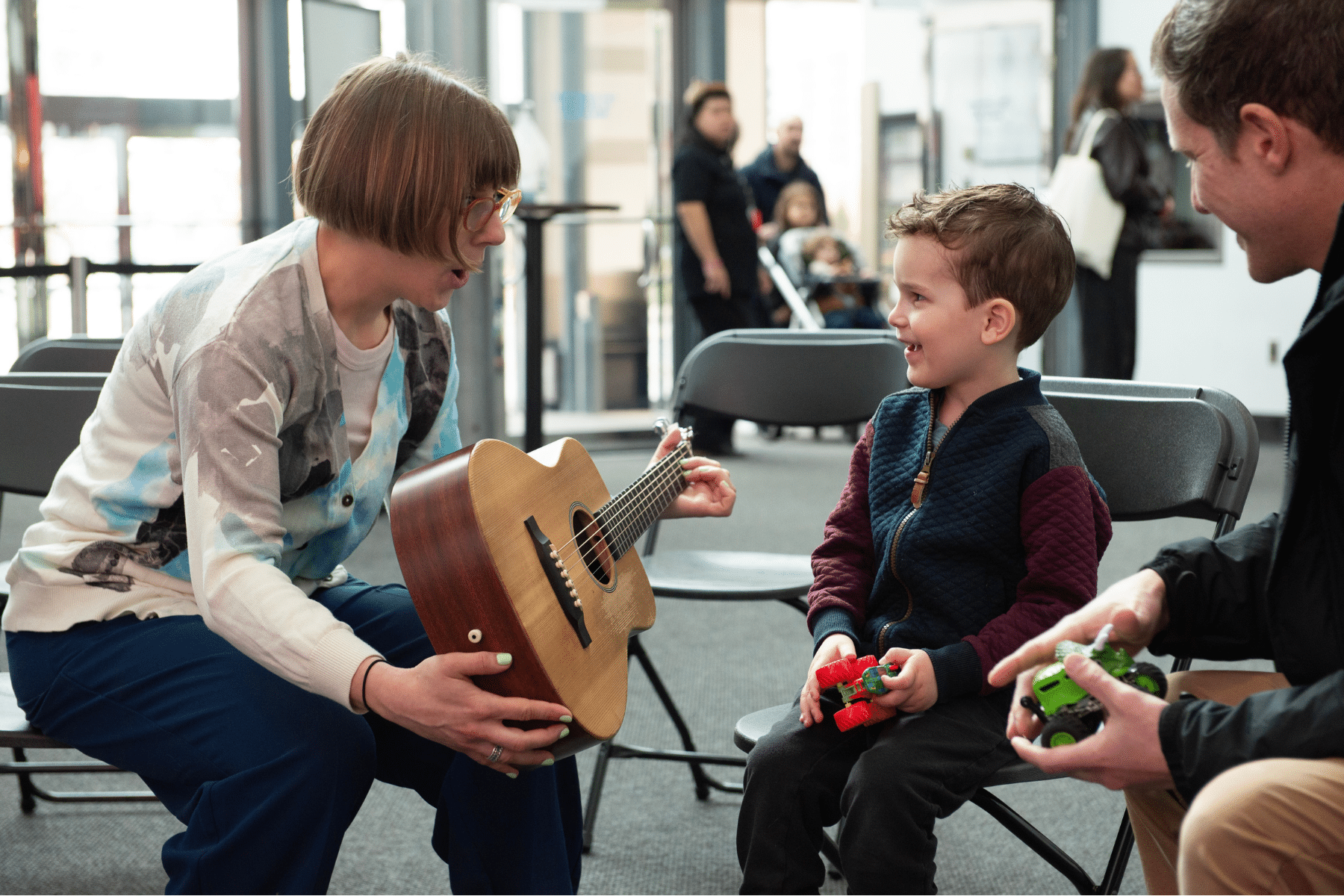
At Xenia Concerts, Bryan can experience music in a way that feels natural to him. He can move. He can interact with instruments before or after a performance. He can enjoy therapy dogs, access sensory tools and be in a space where his needs have been considered before he even arrives. For Lorena, that planning removes a mental load that many caregivers carry constantly. She does not have to enter the room already bracing for a problem.
Over time, Xenia became more than a place Lorena and Bryan attended. After founding Bryan’s Place, a grassroots community organization for youth and adults with disabilities, Lorena connected with Rory about creating volunteer opportunities at Xenia Concerts. Now, members of Bryan’s Place sometimes help at reception tables, welcome guests, hand out materials and support other attendees in accessing sensory equipment.
That shift captures one of the report’s most important ideas: access can become participation and participation becomes belonging. Rory tells a similar story about Thomas, who first came to Xenia Concerts as a child and later joined one of their projects that invited neurodivergent and disabled people interested in composition to create music with professional artists. When Thomas heard his piece played for the first time, he jumped from his chair, waved his pen like a conductor and declared, “I’m a great composer!”
For Rory, that moment says a great deal about what inclusion can become. “Giving somebody access to a space gives them the opportunity to feel a sense of inclusion – to actually be involved as a participant in that space – and then eventually develop a sense of belonging,” he says.
Xenia’s work is intentionally designed to ripple outward. The organization has trained more than 150 artists and works with schools, disability and arts organizations and presenting partners. The goal is not for Xenia to be the only place where people can participate fully in the arts. It is to help more spaces understand what welcome really requires.
“We don’t believe that adaptive concerts should be the only place where people can show up as themselves.”
That belief is what makes this research so important. The report does more than validate Xenia’s concerts. It offers a framework that other organizations can learn from, adapt and build on. It shows that accessibility is not only about removing barriers, though that matters deeply. It is also about supporting and improving the wellbeing of disabled, Deaf and neurodivergent individuals and their caregivers; strengthening communities and changing what people expect from public cultural life.
Xenia Concerts offers a clear understanding of what the healing power of music can mean. Sometimes it is the sound itself. Sometimes it is the chance to touch an instrument, to move freely, to see yourself reflected on stage or to sit beside someone you love without fear of being asked to leave. Sometimes it is knowing that, for once, the room was designed with you in mind.
For Bryan, Lorena says, the joy is simple: “He loves it because he can just be himself while he’s there.” For Xenia, the work is to make that joy possible for more people, in more places, until inclusive arts experiences are no longer the exception. They are the standard.