
Two Paths, One Vision

Azrieli alumni who pursued an MD-PhD talk about what they have learned

Photographs by Shauli Lendner
February 24, 2026 By Kristy Strauss
View PDF version

Training to be both a scientist and a medical doctor is an ambitious goal, and one that’s very challenging to achieve. The first hurdle is finding an academic institution that offers the opportunity to pursue both paths simultaneously. Highly competitive MD-PhD programs that integrate the two disciplines have been offered at a handful of U.S. institutions since the mid-1970s. In Israel, however, the model is still relatively new, with only a handful of schools beginning to offer the dual approach.

Since 2007, the Azrieli Fellows Program has supported a small but growing number of researchers in Israel who have chosen this path. The first Fellow to pursue this academic journey was Naama Elefant-Bernstein, who was determined to earn her PhD in computational biology, systems biology and genomics while simultaneously pursuing an MD at The Hebrew University of Jerusalem. Back then, however, a dual program didn’t exist, and Elefant-Bernstein had to negotiate with the medical school to create the program for herself.

Over the years, the Azrieli Fellows Program has supported nearly 10 researchers who chose to pursue the MD-PhD option through the Azrieli Graduate Studies Fellowship. The Fellowship provides financial support, networking opportunities that encourage interdisciplinary research, and events at which Fellows can connect.

For alumni Fellows like Elefant-Bernstein, Irene Unterman and Leore Heim, however, the Azrieli Fellows Program has meant much more. It was their sounding board and a constant source of encouragement.

Elefant-Bernstein completed her MD-PhD in 2011 and is now a research associate at the Center for Precision Medicine and Genomics at Columbia University Medical Center in New York City. In October 2024, Unterman completed her MD and PhD in biomedical sciences from The Hebrew University of Jerusalem and is currently in a dermatology residency at Hadassah Medical Center in Jerusalem, where she is a Nativ Fellow. Heim is expected to complete his MD and PhD in neuroscience at Tel Aviv University in late 2025 and begin his internship at the Galilee Medical Center in Nahariya.

Aperio contributor Kristy Strauss spoke with the three Fellows to discuss their academic journeys, lessons they have learned and tips for other Fellows pursuing the demanding parallel academic program.
Share this article
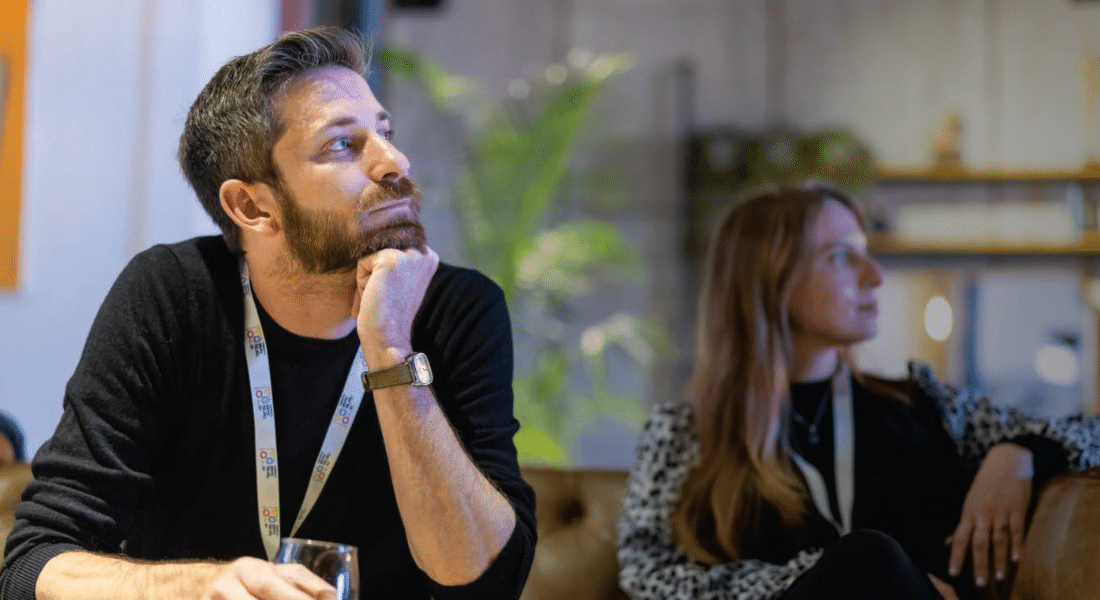
While at The Hebrew University of Jerusalem, Irene Unterman drew heavily on the Azrieli community. “So many opportunities opened up because of small conversations.”

Kristy Strauss: Pursuing a joint MD-PhD degree is an ambitious undertaking. What did you learn during your Fellowship years that you are applying now?

Leore Heim: There are the practical things you learn throughout your education, but the Azrieli Fellowship gave me something more than that. My PhD was one of the most difficult things I have ever done for many reasons — mainly, dealing with day-to-day failures in the lab. But the people I met at Azrieli always had my back and gave me confidence, which has given me the ability to persevere when things get tough. That was really significant, even more than the practical things I learned. Irene Unterman: The Azrieli community was an anchor for me during those years — both my peer group and the Azrieli team who helped me connect with the alumni network and find other people who have been through this journey. I’m no longer afraid to put myself out there and ask questions, and I learned there will always be a strong alumni network that I can turn to for advice.

Naama Elefant-Bernstein: My Fellowship gave me the opportunity to connect with an amazing group of people in my cohort who were so impressive and supportive of each other. Even though we were in different fields, I think we learned different lessons from each other that we apply in our work today.

KS: How did you compartmentalize your thinking and efforts to pursue two demanding areas of study?

NEB: I love science, and I love medicine, and they’re very intertwined paths as far as I’m concerned. I don’t like to consider them as two different disciplines. I am a big believer that doing research makes you a better doctor, and being a doctor makes you a better researcher.

IU: I loved doing each individually. I always thought that there would come a point where I would have to go one way or the other. But along the way, I met many mentors who are active physicians and scientists and incredible at what they do, and they’re able to combine it.

KS: Still, juggling two rigorous programs must have been demanding. What was your biggest challenge and how was it managed?

NEB: The real challenge is finding a place that allows you to do your residency and continue your research after you’ve graduated. There aren’t many options in Israel, so for me, family medicine gave me that one day a week where I could continue my research in genetics. Now, my research and area of medicine are in the same space. But it took a very long time to get here.

“I love science, and I love medicine, and they’re very intertwined paths as far as I’m concerned. I don’t like to consider them as two different disciplines.”
Naama Elefant-Bernstein

IU: For me, it was the frustrating realization that I needed answers but had no one to ask, because those answers didn’t yet exist. It was then that I figured out that in my teeny tiny field of research, I am the expert — and I am responsible for finding the answers I needed. I had incredible mentors, but their job was to help me figure it out on my own. While it was challenging, it gave me a lot of confidence. I learned that I might not know everything — but in this tiny bubble, I know something.

LH: There were many challenges, like maintaining a work-life balance. Dealing with failure was also quite challenging. But it was an eye-opening experience. I discovered a lot about myself — my faults and my strengths — which is priceless.

KS: Leore, how did you manage to achieve work-life balance in the end?

LH: I haven’t found work-life balance yet. Some might say I’m onedimensional because work is a big, big part of my life, and people might say it takes up more of my time than it should. But I struggled for a long time with finding balance, and I think striving for it put me under more stress. Now, I’m just living the way I like, which is long hours, and I’m okay with it.

NEB: To Leore’s point, I think work-life balance is a fictional concept and nobody really has it. It’s good to strive for balance, but it’s tough. There are times when you need to put in long hours, like when you’re studying for exams and you don’t have much of a choice. Work-life balance is something that fluctuates, and we shouldn’t be so hard on ourselves during those moments when work — or life — takes up more of our time.

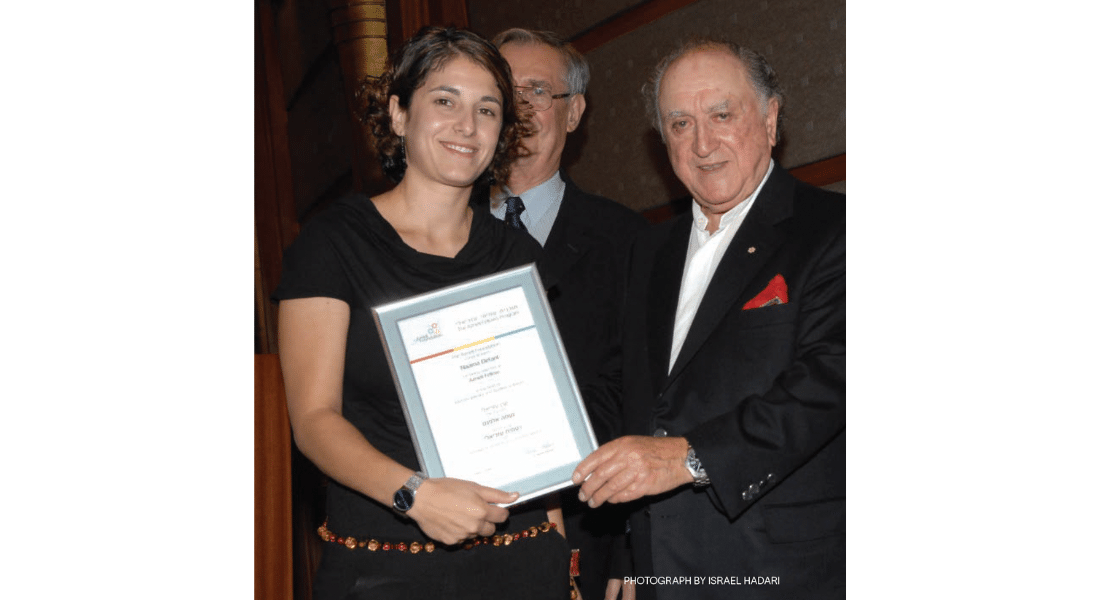
Naama Elefant-Bernstein, the first Fellow to pursue both an MD and PhD simultaneously, with the late David Azrieli at the Fellows’ opening event in 2007. For her, a Fellows-organized visit to a school in Kiryat Gat brought lasting memories.

KS: I’m sure you had some wonderful moments pursuing an MD and PhD. What’s one memory from your involvement with the Azrieli Fellows Program that sticks with you?

IU: If I had to pick one, it would be when I got the call from Azrieli for an interview. They were just so, so friendly on the phone. It was like we had known each other for years, even though we hadn’t even met.

LH: For me, it was the moment I realized I wasn’t alone and overcame my insecurities. One evening, I attended a ceremony that the Azrieli Fellows Program hosted to congratulate all the new cohorts. The program always puts on amazing events, and this was no exception — there was great food, great speeches and everyone was well dressed. I felt a bit shy being recognized in this way, but realizing that other new Fellows had similar feelings broke the ice, and it was beautiful. Suddenly, we were all in the same boat, and it was a reminder that we share the same feelings and stresses.

NEB: One of my best memories came from a volunteer opportunity, which is an important element of the Azrieli Fellows Program. Another Fellow and I went to a school in Kiryat Gat, and we brought a sheep’s heart to dissect with the kids. There was one kid who was beyond excited, and I just saw the sparks in his eyes. It was so moving.

KS: Are there any pro tips you can offer Fellows just starting down a similar path?

IU: Don’t be scared to engage and share your thoughts with the great people running the Azrieli Fellows Program. So many opportunities opened up just because of small conversations I had with them. I felt shy to reach out to them for so long, and when I did, I got such an incredible response.

NEB: My advice would be to stay in touch with other Fellows you meet and with the organization. They’re great people to have in your life. Also, participate in program events, even if you think you’re too busy. Take advantage and be part of it as much as you can.


Subscribe to our newsletter

* indicates required

All fields are mandatory.