Seeds of Survival

By sifting through ancient garbage, archaeobotanist Daniel Fuks finds timeless solutions to modern-day challenges

Photographs by Avital Hirsch
February 23, 2026 By Robert Gerlsbeck
View PDF version

On a sunny day in July, in Israel’s Avdat National Park in the southern Negev Desert, scientists and park staff gathered to pick wine grapes. But this was no ordinary harvest. It was the revival of a tradition 1,500 years old.

The clusters came from a close relative of grapes once cultivated here during the early Islamic period, around 650 to 850 CE, and are presumed to descend from grapes of the Byzantine era, around 350 to 650 CE. In those earlier centuries, the Negev was believed to be a thriving wine hub, exporting its prized vintage across the Mediterranean Sea and as far as northwest Europe.

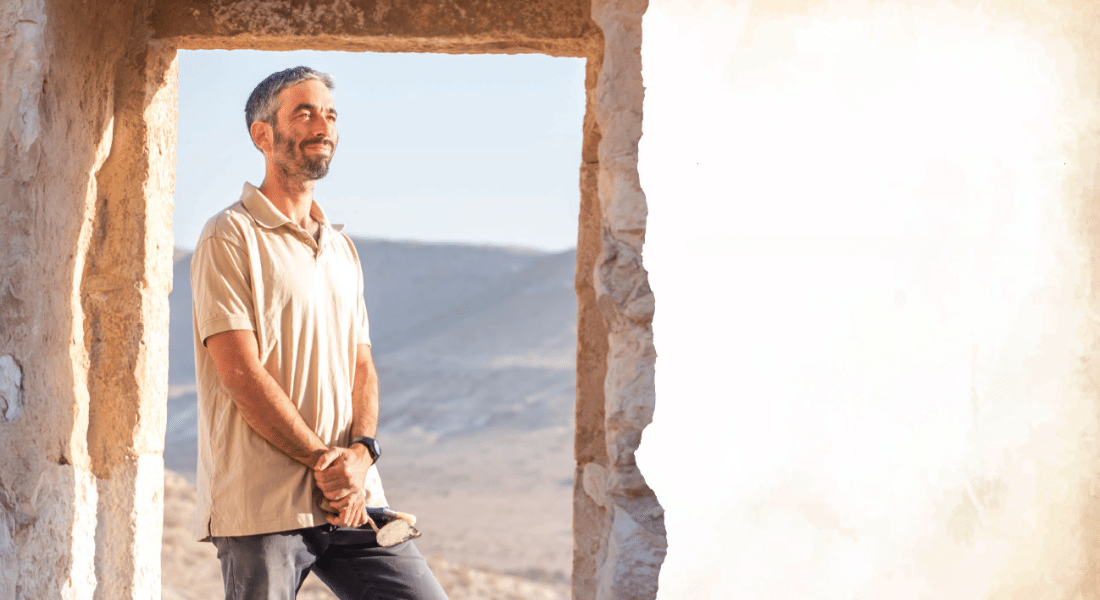
Daniel Fuks, senior lecturer in environmental archaeology at Ben-Gurion University of the Negev and an Azrieli Early Career Faculty Fellow, savoured the moment. Years earlier, he had watched these vines go into the ground. As an archaeobotanist — a scientist who studies ancient plant remains — he had helped bring this moment to life.

Fuks studies seed and fruit remains. His research centres on southern Israel, especially the Negev, during the Roman, Byzantine and early Islamic periods of the first millennium CE, an era rich with agricultural innovation and crop diversification.

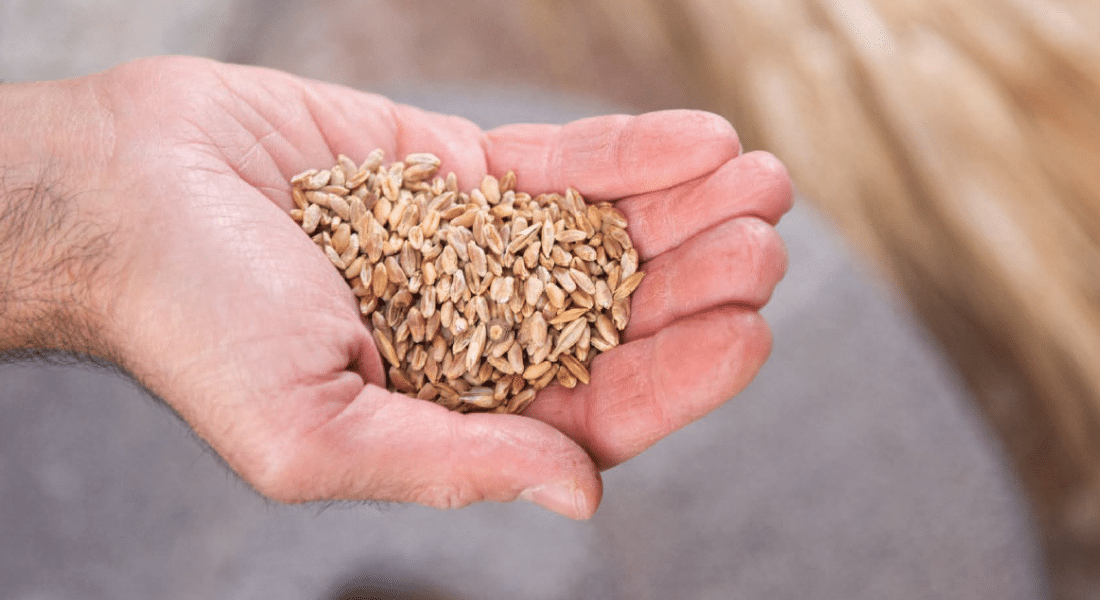
Back in 2016, while a PhD student at Bar-Ilan University, Fuks was notified of a rare find in Avdat. Behind the collapsed walls of a Byzantine building lay a hidden cave painted with Early Christian motifs. Under the rubble were desiccated dung and plant remains, including (as he later discovered) grape seeds, or pips. Such discoveries are like gold for archaeobotanists. Unlike charred seeds left from ancient cooking fires that do not preserve genetic material, these dried pips still carried DNA that originated inside the organisms.

With the help of youth group volunteers, Fuks collected samples and delivered several grape pips for DNA testing. Together, researchers found a close match between the ancient Negev grapes and a modern cultivar grown today. (A cultivar is a plant selectively bred for specific traits.) In 2023, cuttings of this variety were planted in the Negev. This summer, they produced the historic harvest.

For Fuks and his colleagues, the project was more than symbolic. Many common wine grapes today are European varieties suited to mild climates. But as the planet warms and regions grow hotter and drier, resilient strains will be critical. “Since we know this variety grew in the Negev Desert in late antiquity, we expect that it may be especially adapted to heat and arid climates,” Fuks says.

The revival of a desert grape shows how archaeobotany goes beyond history. Fuks’s research spans forgotten crops, the spread of Roman and Islamic agriculture, and ancient plant diversification. Through this work, he helps shine a light on how past societies farmed, how the crops they grew changed over time, and how they adapted to shifting economies, climate change and food-system vulnerabilities. His findings carry lessons for today, touching on biodiversity, food security, globalization and our warming planet.

Archaeobotanists work much like detectives, piecing together past worlds from the smallest plant scraps. Their evidence often comes from ancient waste sites. During a public lecture, Fuks once held up a half-filled black garbage bag and asked his audience: “If we rummage through your trash can, what will we learn about you?” The answer: a lot. A person’s diet, how much coffee they drink, whether they have children, even their economic status. Trash, ancient or modern, tells remarkable stories.
Share this article
“Like a detective, Fuks compares his findings from plant remains with other archaeological evidence and written records from the time, testing how well the stories match.”

By sifting through ancient garbage, archaeobotanist Daniel Fuks finds timeless solutions to modern-day challenges

The stories begin in the field, but much of the work happens later in the lab. And, like detectives, archaeobotanists must consider more than just plant remains. Fuks compares his findings with other archaeological evidence and written records from the time, testing how well the stories match.

That careful approach helped him answer one of the Negev’s enduring mysteries: How big was its wine industry in Byzantine times?

Evidence for local winemaking was first noted in Western scholarship in 1871 by English Orientalist Edward Palmer. Since then, scholars have debated whether Negev wine was mostly for local use or whether farmers produced enough to supply a far-reaching trade network. Some believed the Negev might have been home to the famous “Gaza wine,” a sweet white vintage praised in ancient texts. The tall, narrow Gaza jars, designed for easy transport by camel, have turned up as far away as Germany and England.

To investigate, Fuks studied 11 trash heaps, or middens, from three ancient Negev cities: Elusa, Shivta and Nessana. He compared the number of cereal seeds to grape pips in each.

Why that ratio? The reason is simple. Imagine being a farmer in the Negev around 350 CE. “Say you’ve been given 30 dunum of land [about 3 hectares] to plow, to feed your family. What are you going to plant?” Fuks asks. Most of it, at least 20 dunum, would go to cereal grains, given that bread was a dietary staple. If you drank wine, you might plant another five dunum as a vineyard, with the rest for legumes, vegetables and fruit.

But if word spread that your wine was exceptional, merchants from the port of Gaza might arrive, offering a profitable price that allowed you to buy grain instead of growing it. “So you’ll convert more of your fields to grapes over grains,” Fuks explains. And the shift would show up in the garbage, with the ratio of grape pips to cereal grains rising over time.

That is just what he found. In one midden dating from the first to third centuries CE, grape pips made up only 0.5 per cent of the total grape and cereal seeds. By the fourth to mid-fifth centuries, that had risen to 14 per cent. By the early sixth century, grapes accounted for 25 to 43 per cent in three different middens. Combined with the increase in broken Gaza jar fragments and other evidence, it pointed to a thriving commercial wine industry in the Negev.

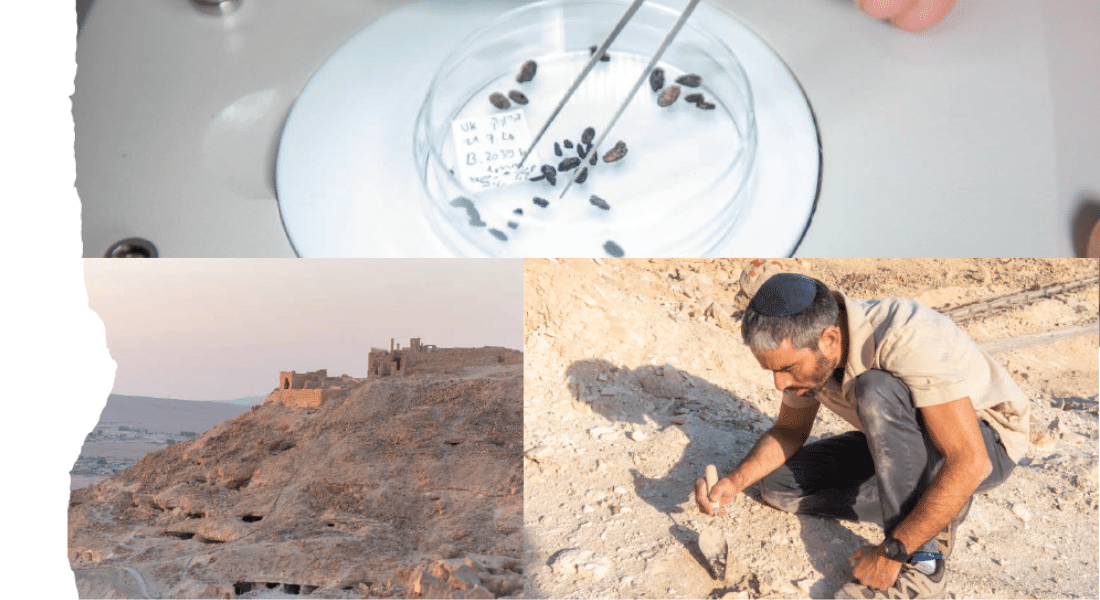
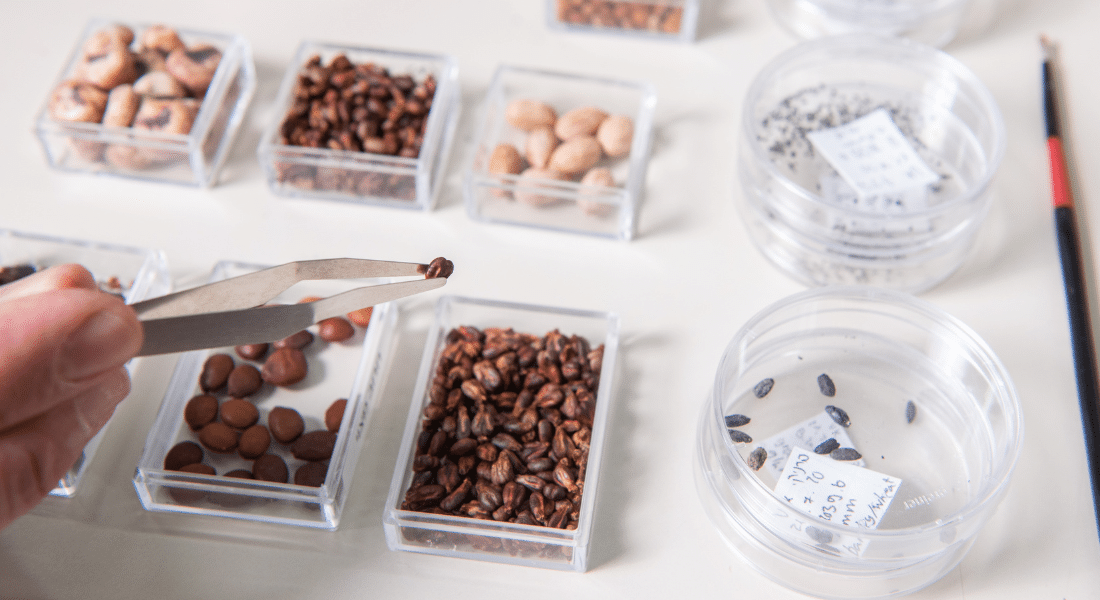
Fuks examines modern seeds that he collects from fieldwork in the Negev Desert. Some of his most significant work came from desiccated dung and plant remains found in a hidden cave at Avdat (below left), site of an ancient Nabataean city in the Negev. In the remains were dried grape seeds, or pips, that still carried DNA that originated inside the organisms. Fuks and his colleagues found a close match between the ancient Negev grapes and a cultivar grown today.

Fuks’s own path to archaeobotany took several turns. Born in Bloomington, Indiana, and raised in Miami, he attended the University of Pittsburgh to study economics and music. “I fell in love with jazz and decided that if there was one thing worth studying at Pitt, it was this,” says Fuks, a saxophonist.

But economics slowly steered him toward archaeobotany. He was interested in Israeli agriculture and the kibbutz system and wrote several college essays about agricultural economics in the modern history of Israel. Then, in the university library one day, he came across a book published in 1982, The Negev: The Challenge of a Desert, describing modern-day efforts to grow crops there using nothing more than collected rainwater. “I was totally struck by this,” he says. A trip to Israel gave him a closer look at its farming systems, and gradually his interest shifted to ancient agriculture.

Over the following years, Fuks earned master’s and doctoral degrees from the Department of Land of Israel Studies and Archaeology at Bar-Ilan University (his PhD work was supervised by Guy Bar-Oz, a professor of archaeology), followed by a post-doctorate at the University of Cambridge.

Fuks’s research examines the major agricultural shifts that took place in southern Israel during the first millennium. By analyzing plant remains from the Negev, he reconstructs the local plant economy and demonstrates, for instance, the impact of what is now called Roman Agricultural Diffusion — a term Fuks coined. Roughly one-third of the domesticated food plants found in the Negev were introduced to the region between the first and fourth centuries CE. Additional crops were added as part of the Islamic Green Revolution in the eighth to twelfth centuries.

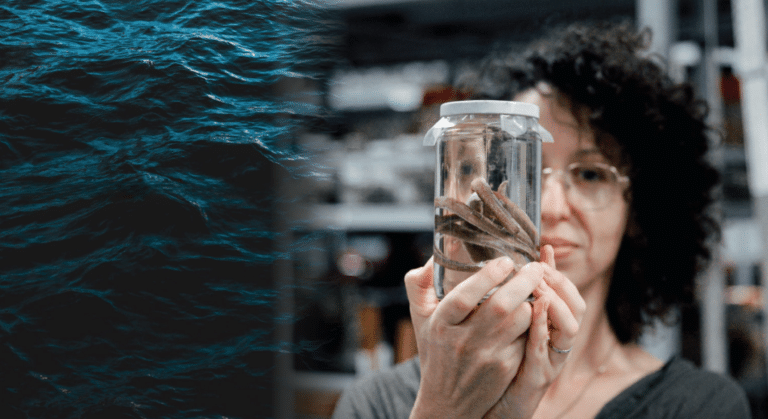
Fuks also studied seeds preserved in animal dung to learn how sheep and goats were cared for, and has carried this further to include collaborations involving multiple scientific techniques to reconstruct ancient livestock diets. “We can use this information to understand where the pellets were produced and in which season,” he says. “Was the animal grazing on material that came from far away or nearby? Were they eating wild plants or being foddered?” Such questions add to researchers’ understanding of ancient economies and ecologies.

Fuks examines modern seeds in his reference collection; storage jars for wine and other agricultural products from the first millennium, signs of a thriving wine industry in the Negev. Fuks founded the global Crop History Consortium in 2022 to study agricultural change over the past two to three thousand years.

Matthew Collins, a professor of archaeology at the University of Cambridge, supervised Fuks when he did his postdoctoral work. “What I like about Daniel is that he’s a creative thinker. For him, plants are a way to understand the connectivity between people,” he says.

While Fuks’s research looks back more than 2,000 years, the lessons of history can feel strikingly relevant, as his research on the ancient Negev wine economy shows.

By the early sixth century, the Negev had become a commercial wine-making hub. But his research also found a drop in the ratio of grape pips to cereal grains in the mid sixth to seventh centuries, suggesting a declining viticulture industry. What went wrong?

The causes are uncertain, but several likely factors converged that are familiar today. Climate change, led by volcanic activity and the Late Antique Little Ice Age, may have brought heavier rains and destructive floods, potentially affecting the viability of Negev commercial viticulture. The decade from 536 to 545 CE was the coldest in the last 2,000 years.

Then came the Justinianic plague of 541 CE (the pandemic of its day) that killed an estimated 20 per cent of populations in cities like Constantinople and Alexandria. The result: labour shortages, sociopolitical turmoil and collapsing demand for luxuries such as wine. Although the emperor Justinian survived the plague, his successors could not keep the empire together; internal strife and economic decline ensued.

Negev farmers may have flourished for a while by plugging into global markets. But the trading that brought wealth also left them vulnerable to climate shocks, disease and shifting markets.

In a public presentation a few years ago, Fuks connected those lessons to the present.

“Even if the Byzantines had special varieties of grapes, it didn’t help them cope with the unexpected challenge of climate change.”

Then he added a call to action: “Unlike them, we have the ability to foresee climate change and some of its effects. We know what’s coming. The question is, Will we be wise enough to prepare for it?”

From Ancient Fields to Future Foods

Imagine doing your weekly grocery shopping. But instead of bananas, oranges and cucumbers, you fill your cart with bitter melon, mountain yam and Ceylon spinach. That’s the “counterfactual world” described in a journal article principally written by Daniel Fuks on the ancient history of so-called “forgotten crops.”

Forgotten crops are plants cultivated by past civilizations and present-day subsistence farmers, but now overshadowed by today’s global staples such as wheat, maize, rice, soybeans, bananas and oranges.

Some forgotten crops survive mostly locally, like the pili nut of the Philippines, the horseradish tree of Southeast Asia or India’s spiny gourd. Others are viewed as having potential for global expansion. Fonio, a West African grain, is marketed as the “next quinoa” — itself once an obscure Andean crop before becoming a trendy North American “superfood” in the early 2010s.

Why did certain crops, such as wheat or sugar cane, spread worldwide while others stayed local? And which ancient crops have been overlooked?

To explore such questions, Fuks founded the Crop History Consortium (CHC) in 2022. It brings together researchers in diverse fields to study agricultural change over the past two to three thousand years. The timeline is vast, reflecting Fuks’s belief that the process by which certain crop species flourished and others receded must have played out many times in history. “The phenomenon of ‘lost’ and ‘forgotten’ crops has a much deeper history than is usually considered,” Fuks has written.

Researchers have found at least 7,000 species used for human food. But only a small number are mass produced today. For example, just three cereals — wheat, maize and rice — make up nearly half of worldwide human caloric intake. The CHC aims to bring together a wide range of disciplines to reconstruct holistic histories of a wide range of crops. In this effort, archaeobotanists like Fuks will be joined by historians, geneticists, ethnobotanists and bioarchaeologists to synthesize data on crops’ trajectories.

Fuks says forgotten crops are worth revisiting, not just for what they can tell us about past societies but for the resilience they might bring to modern farming. To spread the message, the CHC in 2026 plans to launch an online seminar series and begin work on a series of interactive story maps tracing crop histories. “It’s important to understand our agricultural heritage, including how crops moved and established new roots,” he says. “And by doing that we can contribute to sustainable agriculture today.”

Subscribe to our newsletter

* indicates required

All fields are mandatory.